
We earn a commission if you buy through these links. Learn more
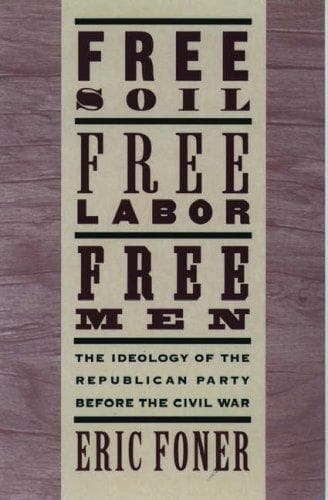
Free soil, free labor, free men
by Eric Foner
Foner shows how antebellum Republicans turned opposition to slavery's expansion into a broad vision of free labor, and why that ideology explains their rise.
What It's About
Published in 1970, the book examines the ideology of the Republican Party in the decade before the Civil War. Foner's central claim is that the party's appeal lay less in a single moral crusade than in a set of linked beliefs: that free soil should keep slavery out of the western territories, that free labor offered every man a path from wage work to independent ownership, and that the slave system threatened those freedoms for white northerners too. Foner traces how these ideas appeared in speeches, newspapers, and party platforms, and how they bound together a movement of former Whigs, Free Soilers, and Democrats who had left their old parties.
The approach is that of a historian reading political rhetoric closely and setting it against its economic and social background. Foner is less interested in biography or battle narratives than in what contemporaries meant when they used words like freedom, labor, and independence. The result is dense in places, since much of the argument rests on careful reading of primary sources, but it is organized around a clear thesis and moves steadily.
Reading it feels like being let into an argument over the meaning of American freedom. It rewards readers who already know the broad outline of the 1850s, including the Compromise of 1850 and the Kansas-Nebraska Act, and it shows how a political vocabulary can carry as much weight as policy details. Some readers will find the focus narrow, but few books explain as clearly why the Republican coalition held together.
Read this if you…
- want a close reading of how 1850s political language shaped the Republican Party
- are studying the origins of the Civil War beyond battles and famous politicians
- are interested in how ideas about work and independence fed into national politics
Skip it if you…
- want a battlefield narrative or a single-figure biography such as one of Lincoln's
- need a short modern survey of Reconstruction or the full history of American slavery
Key Ideas
- 1
Free soil as an organizing principle
Opposition to slavery's spread into the western territories was the party's core commitment. It was framed largely as a defense of land and opportunity for white settlers rather than a direct attack on slavery where it already existed. Foner shows why that framing could unite people who disagreed sharply about race and about the South itself.
- 2
Free labor as a social ideal
The belief that wage work was a stage on the way to independence, where a steady worker could save, buy land, and become his own master. Slavery threatened this ideal by degrading labor and making free workers' dignity look precarious. Foner treats this idea as the emotional and moral center of Republican politics.
- 3
The slave power conspiracy fear
Many Republicans believed a small slaveholding elite was steadily seizing control of the national government. Foner argues this fear gave the party its urgency and explains why ordinary voters could see territorial politics as a direct threat to their own futures.
- 4
Shared language across a divided coalition
The Republicans drew from former Whigs, Free Soilers, and anti-Nebraska Democrats who differed on tariffs, nativism, and race. Foner suggests that a common vocabulary of free soil, free labor, and free men let them act together despite those differences.
- 5
The limits of the free men ideal
The vision of freedom was tied closely to white male independence, and its opposition to slavery was often more about the position of free white workers than about the rights of Black Americans. Foner does not let the ideal look more egalitarian than it was.
Limitations
Written in 1970, the book reflects the historical debates of its time, and the field has moved on since. Later historians have questioned how antislavery the Republicans really were, how much racial conservatism shaped their politics, and whether free labor was as dominant a frame as Foner suggests. The book centers the views of northern political actors, so enslaved people and Black political thought appear mainly as they bear on white northern debates. Read it as a foundational argument rather than the last word.
Questions Readers Ask
- Is Free Soil, Free Labor, Free Men still worth reading?
- Yes. The book remains a standard starting point for understanding antebellum politics, and its free labor framework is still widely discussed. Historians now debate many of its claims, which makes it a useful entry point for seeing how the argument has been tested and revised.
- How does it compare with Foner's later work on Reconstruction?
- This book is a narrower study of ideas before the Civil War, focused on one party's language and beliefs. Foner's later work on Reconstruction covers a much broader period and set of questions. Readers interested in the prewar roots of that later story will find this book a natural prelude.
- Published
- 1970
- ISBN
- 9780195094978
- Difficulty
- intermediate
- Category
- History
Book details and cover from Google Books.
Ready to read Free soil, free labor, free men?
Get your copy on Amazon, or listen to it on Audible. We earn a commission if you buy through these links.