
We earn a commission if you buy through these links. Learn more
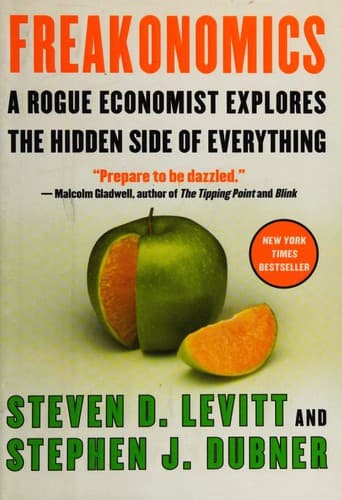
Freakonomics
by Steven D. Levitt, Stephen J. Dubner
Guide by the Books of the Day editors · Updated · How we write our guides
A short, story-driven tour of how incentives shape surprising behavior, from cheating teachers to drug gangs, that teaches you to question easy explanations.
What Creators Say About Freakonomics
2 creators reviewed Freakonomics on YouTube between 2020 and 2024, with 8K views between them. Their opinions are their own; we picked these reviews, we didn't write them.
What It's About
Freakonomics, published in 2005, is a collection of case-study chapters written by economist Steven Levitt and journalist Stephen Dubner. Rather than building one argument from start to finish, it takes the economist's habit of asking what incentives are really at work and points it at unexpected corners of ordinary life. The subjects include schoolteachers who may be cheating on standardized tests, sumo wrestlers whose results bend around a single crucial bout, real estate agents who may not always work for their clients, and parents agonizing over baby names. The method is simple: find an odd question, look for data that can answer it, and accept what it shows.
The writing is much of the appeal. Dubner brings a magazine writer's sense of pacing, so each chapter opens with a concrete puzzle, moves through the evidence in plain language, and ends with a result that reframes something the reader took for granted. No advanced math is required, and the authors explain statistical reasoning in everyday terms. The chapters are short and can be read in any order, which makes the book easy to pick up and put down.
Reading it feels more like a brisk, curious conversation than a textbook. Some chapters are stronger than others, and the authors' confident tone sometimes outruns the evidence, which is part of why the book sparked debate among economists and social scientists. Expect to finish with a sharper eye for hidden motives and a healthy suspicion of conventional explanations, rather than a unified theory of how the world works.
Read this if you…
- are curious about why people do things that look irrational from the outside
- want an accessible introduction to economic thinking without equations
- enjoy short, self-contained stories and quick conversational writing
Skip it if you…
- want a rigorous, sustained argument about a single economic topic
- are looking for practical advice on personal finance or running a business
Key Ideas
- 1
Incentives explain more behavior than we admit
The core lens of the book is that people respond to the rewards and penalties around them, often in ways that differ from what they say they value. The authors show how a bonus, a fee, or a reputational stake can quietly shape choices in classrooms, sales offices, and sporting events. Once you start looking for incentives, many puzzling behaviors become predictable. The lesson is less about greed than about how structures steer ordinary people.
- 2
Cheating leaves statistical fingerprints
A recurring thread is that people who cheat tend to leave patterns in the data. The book uses anomalies in test answer sheets and similar records to show how dishonesty can be detected without a confession. Rather than asking people whether they cheat, it looks for irregularities that rarely occur by chance. Readers get a practical sense of how data can expose what people hide.
- 3
Conventional wisdom deserves a second look
Many chapters take a widely held belief and test it against evidence, sometimes with surprising results. The authors are willing to challenge intuitions about crime, parenting, and expertise, and they show how a little data can overturn a comfortable story. The approach encourages skepticism toward confident explanations, including their own. That willingness to question assumptions is the book's most durable contribution.
- 4
Information gaps favor the expert
Several chapters examine markets where one party knows more than the other, such as home sales and specialized trades. The authors argue that these gaps can distort outcomes in ways that hurt ordinary buyers and clients. They describe how professionals may act for their own benefit even when they appear to serve others. The point is not that experts are villains but that their incentives may not match yours.
Limitations
The book has drawn sustained criticism. Some economists argue that the authors' most provocative claims, including a link between legalized abortion and later crime drops, rest on contested interpretations of data, and the book's tone can make tentative findings sound settled. Because it covers many unrelated topics, it offers breadth rather than depth, and it does not provide a general framework or practical guidance. Some examples, such as the parenting and naming chapters, may feel more dated or less robust than they did when published.
Questions Readers Ask
- Is Freakonomics still worth reading?
- Yes, mostly for its method. Some specific examples have been debated or updated by later research, and the data comes from the mid-2000s. But the habit of asking what incentives are at work and checking claims against evidence remains useful. Read it as a set of case studies in thinking rather than as a set of settled facts.
- How does it compare with Thinking, Fast and Slow?
- The two books overlap in how they explain human reasoning, but they differ in approach. Kahneman's book is a sustained tour of psychology and cognitive biases, dense with research and more demanding. Freakonomics is lighter and more story-driven, focused on incentives and data in everyday settings. Choose Freakonomics for an easy entry point, and Kahneman if you want depth.
- Published
- 2005
- ISBN
- 9780061234002
- Difficulty
- beginner
- Category
- Business
Book details and cover from Google Books.
Ready to read Freakonomics?
Get your copy on Amazon, or listen to it on Audible. We earn a commission if you buy through these links.