
We earn a commission if you buy through these links. Learn more
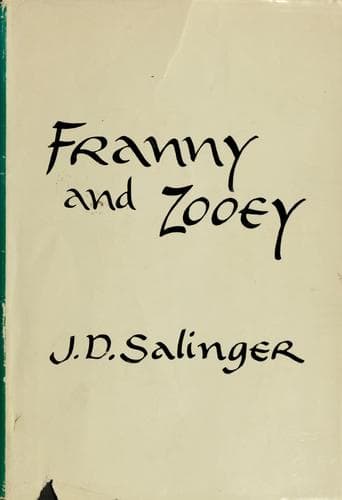
Franny and Zooey
Guide by the Books of the Day editors · Updated · How we write our guides
Two linked novellas where talk is the action: a college student in spiritual crisis and the brother who tries to talk her back, sharp, funny, and strangely tender.
What Creators Say About Franny and Zooey
2 creators reviewed Franny and Zooey on YouTube between 2008 and 2020, with 325.7K views between them. Their opinions are their own; we picked these reviews, we didn't write them.
What It's About
Franny and Zooey is two linked novellas by J. D. Salinger, first published separately in The New Yorker in the 1950s and brought together as one book in 1961. The first, Franny, follows a young college woman who comes home for a weekend visibly coming apart, caught between her hunger for something spiritual and her disgust at the vanity she sees in the people around her, herself included. The second, Zooey, turns to her brother, a television actor, who sets out to talk her back to steadiness.
The book runs on conversation. Much of it is dialogue, quick and funny, with Salinger's ear for how young people perform sincerity and how fast they catch each other doing it. The second half is largely one long, confrontational exchange that moves through religion, art, ego, and the family's dead older brother Seymour, who hangs over everything without appearing. Salinger's prose is precise and a little sly, and his interior passages slide from wit toward something close to prayer.
Reading it feels like eavesdropping on a family that is brilliant, a bit ridiculous, and quite raw. It rewards patience with the long speeches and attention to what characters avoid saying.
Read this if you…
- want a character-driven story about young people wrestling with faith and ego
- enjoy long, argumentative dialogue more than a fast-moving plot
- already love the voice of The Catcher in the Rye and want more of it
Skip it if you…
- need a plot that moves steadily toward a clear payoff
- find religious discussion tiresome or preachy in fiction
Key Ideas
- 1
Spiritual seeking versus spiritual performance
Franny is drawn to a devotional life of quiet repetition, but she worries that even her seeking has become a display. The book asks whether anyone can pursue something sacred without turning it into another way to be seen. Its answers are not tidy, and the question matters more than the resolution.
- 2
Ego as the main obstacle
Salinger treats self-consciousness as the thing that spoils almost every act, from acting and teaching to ordinary talk. Characters are constantly measuring themselves against an imagined audience. The novellas suggest that freedom comes from doing things for their own sake, though the characters argue about what that really means.
- 3
Seymour as an absent center
The older brother is dead by the time of the story, yet he shapes how the surviving siblings think, speak, and judge themselves. Much of the family's inner life revolves around his memory and his teachings. Readers who know the other Glass family stories will feel his presence more fully.
- 4
Dialogue as characterization
Salinger builds people through how they talk: their evasions, interruptions, and sudden candor. Plot moves slowly, so the pleasure lies in the rhythm of argument and the small revelations inside it. The style is intimate and conversational, close to the voice of a late-night talk you cannot stop listening to.
Limitations
The long second-half monologue can feel self-satisfied, and some readers find its moral certainty more irritating than moving. The Glass children are precocious and privileged, and their mannered wit can read as a closed world. Franny is seen mostly through her family's eyes, which some critics feel limits her as a character. The religious material is specific to a particular devotional tradition and to mid-century New York, so some references need a little context. The book also leans on the Seymour mythology, which can feel insular to new readers.
Questions Readers Ask
- Do I need to read The Catcher in the Rye or the other Glass family stories first?
- No. Franny and Zooey stands on its own, with enough background about the family to follow it. Readers who know the other Glass stories will catch more of the references to Seymour and the siblings' shared history. Starting here is perfectly fine, though you may want to read the others afterward to fill in the family picture.
- Is Franny and Zooey still worth reading today?
- Yes, especially if you care about voice and dialogue. Its questions about authenticity, status, and the pull of spiritual life still feel current, even though the New York setting and cultural references are firmly mid-century. The book works best as a close, almost theatrical portrait of two siblings, and that intimacy has not dated.
- How does it compare to The Catcher in the Rye?
- Catcher is more propulsive, with a single narrator whose voice carries the whole book. Franny and Zooey is slower and more talk-driven, with multiple perspectives and a second half built around a long argument. Readers who loved Holden's voice often enjoy this book, but they should expect a quieter, more argumentative experience.
- Published
- 1961
- ISBN
- 9780553203486
- Difficulty
- intermediate
- Category
- Fiction
Book details and cover from Google Books.
Ready to read Franny and Zooey?
Get your copy on Amazon, or listen to it on Audible. We earn a commission if you buy through these links.