
We earn a commission if you buy through these links. Learn more
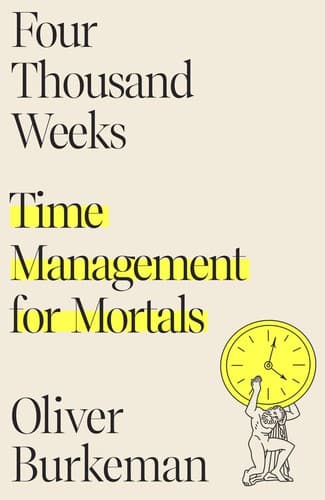
Four Thousand Weeks
Guide by the Books of the Day editors · Updated · How we write our guides
A calm, philosophical case that no amount of time management will make a finite life feel finished, and a practical guide to choosing what matters within it.
What Creators Say About Four Thousand Weeks
2 creators reviewed Four Thousand Weeks on YouTube between 2021 and 2025, with 657K views between them. Their opinions are their own; we picked these reviews, we didn't write them.
What It's About
Four Thousand Weeks is Oliver Burkeman's 2021 book about the gap between how long a human life lasts and how much we want to do with it. Its starting point is arithmetic: a typical lifespan adds up to roughly four thousand weeks, a sobering figure once you consider how many emails, projects, places and relationships compete for them. Burkeman argues that the usual response, better productivity systems and tighter scheduling, promises a sense of control that never arrives, because the list simply regrows.
Rather than offering another set of hacks, the book makes a case for accepting limits. It moves between the history of time management, psychology, philosophy and the reflections of people who lived with constraints, and it keeps returning to practical questions about what to pay attention to and what to let go. The tone is warm, wry and conversational, with short sections that are easy to read in one sitting. It often asks you to pause and question your assumptions rather than follow instructions.
The experience is less like a manual and more like a long conversation that gradually shifts how you think about your days. Some readers find it genuinely freeing; others find its reflective method slow going if they wanted a structured system. It rewards patient reading, and it lands hardest when you recognise your own habits on the page.
Read this if you…
- feel perpetually behind no matter how well you organise your days
- are tired of productivity advice that promises a clear inbox and never delivers
- want a thoughtful, humane way to decide what deserves your limited time
Skip it if you…
- want a step-by-step system with templates, frameworks and measurable targets
- are facing real structural overload, such as financial precarity or unmanageable caring duties, and need concrete practical help
Key Ideas
- 1
Time management cannot create the time you want
Efficiency gains tend to be absorbed by new demands, so getting through your to-do list becomes an impossible target. The book uses this to show why the goal of clearing everything keeps moving away, and why the problem is structural rather than personal failure.
- 2
Limits make meaningful choices possible
You cannot do everything, so choosing is unavoidable. Burkeman suggests treating that fact as the basis for deciding what matters, instead of pretending that a sufficiently organised person could say yes to every opportunity. Ignoring what you will not do tends to leave you drifting.
- 3
Attention is the resource that really runs out
The book shifts the focus from tasks to attention, which is scattered by notifications, options and the constant sense that something else deserves a look. Protecting attention for a few things you care about is presented as more realistic than trying to master every demand on it.
- 4
Living well with unfinished business
Unfinished work, unmet expectations and unexplored paths are part of any life, not evidence that you have failed. The book encourages readers to make peace with incompleteness, arguing that the pursuit of a perfectly optimised life is itself a trap.
Limitations
Critics sometimes find the book repetitive, since its central point is made in many ways across its length. Its lessons are more about attitude and perspective than tactics, so readers seeking concrete methods will be disappointed. Some find the message of acceptance drifts toward resignation, and it says little about how workplaces or economic systems create overload. It is a book about personal orientation more than systemic change.
Questions Readers Ask
- Is Four Thousand Weeks a productivity book?
- Not in the usual sense. It is critical of productivity culture and does not offer a system for getting more done. Its aim is to help you decide what is worth your limited time and to relax about what you will never get to. If you want task management techniques, you will need to look elsewhere.
- How does it compare to Stoic or mindfulness books?
- It shares some ground with Stoic writing on mortality and with mindfulness on attention, but it is more focused on time and choice in modern working life. Readers who enjoy those traditions often find it a practical bridge, though it is lighter on spiritual or philosophical doctrine than a dedicated Stoic text.
- Published
- 2021
- ISBN
- 9780374715243
- Difficulty
- beginner
- Category
- Business
Book details and cover from Google Books.
Ready to read Four Thousand Weeks?
Get your copy on Amazon, or listen to it on Audible. We earn a commission if you buy through these links.