
We earn a commission if you buy through these links. Learn more
Founding Brothers
Guide by the Books of the Day editors · Updated · How we write our guides
Ellis examines six turning points in the early republic to show how the founders' personal rivalries and friendships shaped the new nation's politics.
What Creators Say About Founding Brothers
2 creators reviewed Founding Brothers on YouTube between 2009 and 2014, with 14.4K views between them. Their opinions are their own; we picked these reviews, we didn't write them.
What It's About
The category listed for this page says Fiction, but Founding Brothers is nonfiction: a popular narrative history by Joseph J. Ellis, who won the Pulitzer Prize for General Nonfiction for it. Rather than surveying the whole Revolution, Ellis picks a handful of episodes from roughly the 1780s to the early 1800s and examines each closely. The cast is familiar: Washington, Adams, Jefferson, Madison, Hamilton, and Burr. What sets the book apart is its attention to the relationships among these men, their friendships, grudges, and private letters, and how those bonds influenced public decisions.
Ellis writes in a brisk, conversational style that favors scene-setting and clear argument over footnote-heavy scholarship. Each episode centers on a specific conflict or compromise, so the book reads more like a set of connected essays than a continuous chronology. It is accessible and quick to read, and it rewards readers who want to see how the political fights of the 1790s, over money, foreign policy, and the power of the federal government, were argued by people who knew each other well.
The book is best approached as an interpretive portrait rather than a complete account. Ellis is opinionated and often makes confident judgments about motives that the surviving evidence can only partly support. Readers who want a balanced, comprehensive history of the period will need to supplement it.
Read this if you…
- want a readable, character-driven look at the politics of the early republic
- already know the broad outline of the Revolution and want its personalities and quarrels
- are curious how the new federal government actually worked in its first decades
Skip it if you…
- want a comprehensive, footnote-heavy scholarly history of the period
- expected a novel or a dramatized story with invented scenes
Key Ideas
- 1
Founders as people, not monuments
Ellis treats the founders as men with rivalries, insecurities, and loyalties. He argues that their temperaments and personal histories shaped the country's early institutions as much as their stated principles did, which makes the figures feel less like statues and more like colleagues who sometimes disliked one another intensely.
- 2
Compromise as the engine of the republic
Several of the book's episodes show how bargaining, not just principle, produced key outcomes. Ellis emphasizes deals struck behind closed doors, where political necessity and personal relationships mattered. The lesson is that the Constitution's early success depended on practical give-and-take as much as on high ideals.
- 3
Shared revolution, bitter division
Men who had fought together for independence split over the nature of the new government. Ellis argues that their earlier bonds made the disagreements feel personal and intense, and that this split helped give rise to organized party politics. The book's central tension is how a band of brothers became rivals.
- 4
The deferred question of slavery
Ellis points to the way the founding generation largely postponed confronting slavery, even as it wrote a national framework that depended on it. The book does not make this its sole subject, but it returns to the question as a quiet, unresolved problem running beneath the public debates it describes.
Limitations
Ellis's voice is confident, and critics argue that he sometimes presents contested interpretations as settled, especially about the motives of individual men. The book covers only a selection of episodes, so it does not offer a full chronology of the period. Its focus on elite men means enslaved people, Native nations, women, and ordinary citizens receive comparatively little attention. Later historians have built on, and in places challenged, its conclusions, so it is best read as one informed perspective.
Questions Readers Ask
- Is Founding Brothers a novel or nonfiction?
- It is nonfiction. Although this page lists it under Fiction, Ellis's book is a work of popular history drawing on letters, diaries, and public records. Its narrative style can feel like storytelling, but the events and people described are real, and the author's interpretations are presented as arguments rather than invented scenes.
- Who is Founding Brothers best for?
- It suits general readers with some interest in American history who want an engaging introduction to the founding era's personalities. It is less suited to specialists looking for new archival research, because Ellis synthesizes known material and offers his own interpretation rather than presenting extensive original findings.
- How does it compare to David McCullough's John Adams?
- McCullough's book follows one man's life in depth across decades. Ellis covers several figures across a set of focused episodes, so he gives you a wider view of how the founders interacted but less of any single life. Readers who want a single biography might prefer McCullough, while those interested in the relationships among the founders may find Ellis more rewarding.
- Published
- 2000
- ISBN
- 9780375405440
- Difficulty
- beginner
- Category
- Fiction
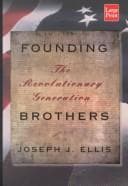
Book details and cover from Google Books.
Ready to read Founding Brothers?
Get your copy on Amazon, or listen to it on Audible. We earn a commission if you buy through these links.