
We earn a commission if you buy through these links. Learn more
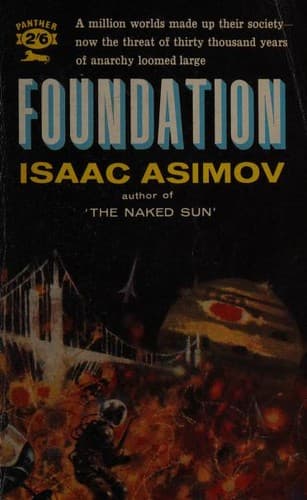
Foundation
by Isaac Asimov
A galactic-scale science fiction classic about an empire's slow decline and a bold plan to shorten the dark age that follows, told as linked stories rather than one continuous novel.
What It's About
Despite its category, Foundation is science fiction, not history. Asimov wrote it as a set of connected stories that imitate the shape of a historical chronicle. The setting is a huge human empire spanning the galaxy, and the book follows the consequences of a mathematician's forecasting method called psychohistory, which claims that the behavior of very large populations can be predicted even when individuals cannot. That premise drives the whole book.
The reading experience is more like a series of essays with dramatic episodes than a conventional novel. Each section jumps forward in time, introduces new leaders and crises, and moves on before any character becomes deeply familiar. Asimov's prose is plain and brisk, often expository, and the pleasure comes from watching ideas about power, planning, and human behavior play out across generations.
If you want rich interiority and emotional closeness, this will feel distant. If you enjoy thinking about how societies rise, fracture, and try to steer their own futures, it is one of the most influential books in the genre and still rewards a careful, patient read.
Read this if you…
- enjoy science fiction where big ideas are the main event
- are curious about how societies rise, fall, and try to plan their futures
- want a classic that shaped the genre and still reads quickly
Skip it if you…
- need vivid characters and close emotional drama to stay engaged
- expect a single continuous plot with steady suspense from start to finish
Key Ideas
- 1
Predicting society through statistical laws
The central conceit is that human crowds behave in ways that can be modeled mathematically, much as gas molecules obey thermodynamics. Asimov makes this idea feel plausible enough to drive the plot, while the book keeps returning to its limits: predictions work only when the population is large and does not know it is being predicted.
- 2
Planning to shorten a coming dark age
Rather than trying to stop a collapse, the book asks what a small group can do to make the aftermath briefer. The question of whether deliberate intervention in history is wise, and who gets to decide, sits underneath nearly every episode.
- 3
Knowledge as a tool of survival
Much of the story concerns preserving technical knowledge and institutions when the wider order breaks down. Asimov treats libraries, encyclopedias, and trained specialists as the real foundations of civilization, which gives the book an unusually intellectual sense of stakes.
- 4
Power that moves between force and influence
The book repeatedly shows how authority shifts from military strength to trade, religion, and persuasion. Readers interested in political theory will notice how Asimov tests the idea that influence can outlast armies, and how easily rulers mistake one for the other.
Limitations
The characterization is thin, and many figures exist mainly to advance the argument. Women are largely absent from the central roles, which reflects its 1940s and 1950s origins and feels dated to many modern readers. The prose is functional rather than lyrical, and the scientific premise is more asserted than explained. Asimov later expanded the series, but the first book's compressed, episodic structure can feel abrupt. Readers who want modern prose and a diverse cast may find better fits elsewhere in the genre.
Questions Readers Ask
- Is Foundation actually history?
- No. It is a science fiction novel, though it imitates a historical chronicle, with a fictional empire, invented institutions, and a made-up forecasting science. It is useful for thinking about history and power, but it is not a factual account of any real period. Searchers looking for nonfiction on the fall of Rome or similar events will want a different book.
- Should I read Foundation before other classic science fiction?
- It works well as a starting point if you want to see how the genre handled big ideas in the mid-twentieth century. It is shorter and more idea-driven than many classics. If you prefer character-focused epics, Frank Herbert's Dune may suit you better, since it spends far more time with individual people and their inner lives.
- Published
- 1951
- ISBN
- 9780007270422
- Difficulty
- beginner
- Category
- History
Book details and cover from Google Books.
Ready to read Foundation?
Get your copy on Amazon, or listen to it on Audible. We earn a commission if you buy through these links.