
We earn a commission if you buy through these links. Learn more
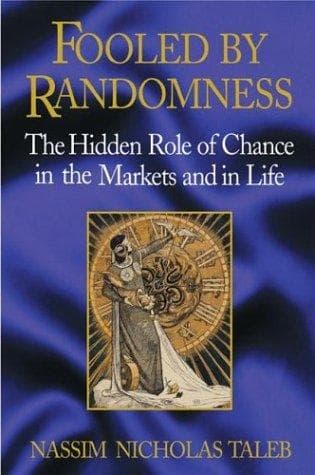
Fooled by randomness
Taleb's sharp, skeptical case that luck often masquerades as skill, showing how survivorship bias and hindsight distort how we judge success in markets and in life.
What It's About
Fooled by Randomness is Nassim Nicholas Taleb's book about how chance shapes outcomes and how poorly our minds handle that fact. Written after years working as a trader and risk manager in derivatives, it argues that we consistently mistake luck for skill, especially when money, careers, and reputations are involved. Taleb contends that markets and everyday life are full of results driven by randomness, yet human brains are built to find patterns and causes, so we tell confident stories after the fact and believe them.
The book reads less like a tightly built argument than a set of loosely linked essays, delivered in a first-person voice that is combative, sardonic, and often digressive. Taleb draws on probability, ancient skeptical philosophy, Montaigne, literature, and his own experience on trading floors. Expect repetition, asides aimed at bankers and academics, and a steady supply of aphorisms. It rewards slow reading and a willingness to be irritated by a writer who enjoys provoking.
Reading it feels like sitting across from a sharp, skeptical companion who keeps asking how you know what you think you know. It is a book that changes how you hear success stories and how you weigh your own wins, rather than a manual with steps to follow.
Read this if you…
- work in finance, risk, or any field where results are noisy and you want to think more clearly about luck
- enjoy skeptical, opinionated writing and don't mind a digressive structure
- are suspicious of success stories and want a sharper sense of why they mislead
Skip it if you…
- want a step-by-step guide to investing or career strategy, since this is more a critique of how we judge them
- find a combative tone and frequent repetition more tiring than the ideas are rewarding
Key Ideas
- 1
Outcomes are not the same as decisions
A good result can come from a poor decision, and a sound decision can produce a bad result. Taleb argues that judging people only by outcomes rewards luck and punishes prudence. Separating the quality of a choice from the result it happened to produce is the book's most practical lesson, and it applies well beyond finance.
- 2
Survivorship bias hides the losers
Those who fail tend to disappear from view, so the visible sample of successful traders, investors, or companies looks more skilled than it really is. Taleb presents this as a systematic distortion in how we learn from history, and encourages readers to ask who is missing from the data in front of them.
- 3
Hindsight makes randomness look like destiny
After an event, we build a tidy causal story and forget the alternatives that could just as easily have happened. Taleb urges readers to imagine other paths history might have taken, which makes success look less inevitable and failure less like a moral verdict.
- 4
Probability as a habit of mind
Taleb is less interested in equations than in intuition about rare events and the limits of averages. He argues that people routinely underestimate how much unlikely outcomes matter in markets and careers, and he pushes for humility about what we can actually know.
- 5
Skepticism as protection against self-deception
Drawing on ancient skeptics, Taleb treats doubt toward your own narratives as a practical defense rather than a cynical pose. The book's larger aim is to make readers more suspicious of the stories they tell themselves about why things went well or badly.
Limitations
Critics point to repetition, a self-regarding tone, and a loose structure that can feel more like a collection of provocations than a unified argument. Some readers find the dismissive treatment of academic economics unfair, and the trader persona blurs the line between memoir and argument. It is not a systematic textbook on probability and offers few concrete tools for applying its ideas. Many market examples reflect the early 2000s, and Taleb's later work, especially The Black Swan, develops and sharpens several of these themes.
Questions Readers Ask
- Is Fooled by Randomness still relevant?
- Yes. Its core points about survivorship bias, hindsight, and the difference between luck and skill still apply to investing, business, and media coverage of success stories. Some of the specific financial examples feel dated, but the psychological observations hold up well and are easy to carry into other fields.
- How does it compare to The Black Swan?
- Fooled by Randomness is the earlier and more personal book, focused on how chance distorts our judgment of success and failure. The Black Swan builds on these ideas with a broader argument about rare, high-impact events. Many readers start with The Black Swan, but this book is a useful companion if you want the origin of those ideas.
- Published
- 2001
- ISBN
- 9781587991844
- Difficulty
- intermediate
- Category
- Business
Book details and cover from Google Books.
Ready to read Fooled by randomness?
Get your copy on Amazon, or listen to it on Audible. We earn a commission if you buy through these links.