
We earn a commission if you buy through these links. Learn more
Focus
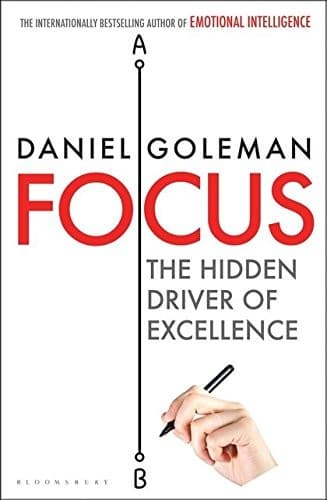
Goleman's Focus is a nonfiction argument that attention, not just talent or effort, drives performance and relationships, and it offers a usable three-part way to think about it.
What It's About
Focus is a nonfiction book about attention, and it is not a novel, despite the Fiction category listed for this page. Goleman's central claim is that attention is the basic resource behind almost everything people do well, from learning a skill to running a team to getting along with a partner. He sorts attention into three kinds: inner focus, which is awareness of your own thoughts, feelings and values; other focus, which is the ability to read and respond to people; and outer focus, which means taking in the larger systems and consequences around a situation.
The approach is part science overview and part practical guide. Goleman draws on research from neuroscience, psychology and organizational studies, and he moves between the lab and the workplace without much warning. Expect a steady, accessible tone rather than dense technical writing. Much of the book is about why attention is fragile, how distraction and constant digital demands wear it down, and what habits can strengthen it.
Reading it feels like being walked through ideas you may already half-know, then given a frame to organize them. It rewards readers who want to think about their own habits, and it reads more like a sustained argument than a collection of tips.
Read this if you…
- want a clear framework for thinking about attention and its role in work and relationships
- manage people or teams and want to understand why some leaders notice more than others
- feel constantly distracted and want an explanation grounded in research rather than productivity hacks
Skip it if you…
- came looking for fiction, since this is nonfiction despite the category listed here
- want a step-by-step program with exercises to follow every day
Key Ideas
- 1
Attention as the hidden driver of excellence
Goleman's starting point is that how well we attend shapes what we notice, learn, and decide, so it underlies skill and judgment across nearly every field. He treats attention less as a fixed personality trait and more as a capacity that can be trained, neglected, or overloaded, which is why he argues it deserves to be managed as seriously as time or money.
- 2
Inner focus: knowing your own mind
The first category is attention turned inward, toward your own feelings, values, and impulses. Goleman argues that people who notice their emotional reactions and stay aware of what they actually care about make better choices under pressure. The section connects self-awareness to everyday performance, such as staying steady in a difficult meeting or noticing when a goal has quietly stopped mattering.
- 3
Other focus: reading and responding to people
Other focus is attention directed at the people around you, including their emotions, intentions, and needs. Goleman links it to empathy and social skill, and suggests that a leader or colleague who listens closely will catch problems a distracted peer misses. Because it builds on his earlier work on emotional intelligence, readers familiar with that book will recognize much of the territory.
- 4
Outer focus: seeing the larger system
Outer focus means widening the lens to take in the environment, the wider organization, and the downstream effects of decisions. Goleman argues that many failures come not from lack of effort but from attention that stays too narrow to see how parts interact. This is the most abstract of the three types, and the most useful for anyone managing complex work.
- 5
Why attention is so easy to lose
A recurring thread is how fragile attention has become in an environment built to pull it apart. Goleman discusses constant interruption, digital notifications, and the cost of switching tasks, and argues that protecting focus is a deliberate practice rather than a matter of willpower alone. The point lands hardest for readers who feel busy but rarely finish deep work.
Limitations
A fair objection is that the book sometimes stretches research from one setting into very different ones, so the workplace examples carry more weight than the laboratory evidence. Goleman's summaries are accessible but not exhaustive, so readers who want primary sources will need to follow up themselves. The advice is also less concrete than some productivity titles, and the three-part framework can feel tidier than the messy reality it describes.
Questions Readers Ask
- Is Focus by Daniel Goleman a novel?
- No. Focus is nonfiction about attention and how it shapes performance and relationships. The Fiction category listed for this page appears to be an error in the listing data, and this page describes the actual book. If you are looking for a novel, this book will not meet that need.
- How does Focus compare to Emotional Intelligence?
- Emotional Intelligence is the broader and more famous book, covering emotion and social skill in general. Focus narrows the lens to attention and treats it as the mechanism beneath those skills. Readers who liked the earlier book will find familiar ground, but Focus is more about how to direct awareness than about defining emotional competence.
- Published
- 2013
- ISBN
- 9780062114976
- Difficulty
- beginner
- Category
- Fiction
Book details and cover from Google Books.
Ready to read Focus?
Get your copy on Amazon, or listen to it on Audible. We earn a commission if you buy through these links.