
We earn a commission if you buy through these links. Learn more
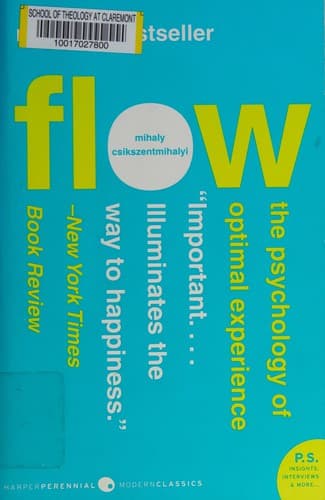
Flow
A rigorous, readable account of the mental state where absorption feels effortless, and a useful framework for judging how you spend your working and free time.
What It's About
Flow is nonfiction, a work of psychology built on decades of research, despite being listed here under fiction. Csikszentmihalyi wants to explain why people often report feeling their best not while relaxing or being entertained, but while absorbed in demanding activity such as climbing, surgery, chess, composing, or a hard job done well. He names that state flow and spends the book describing what it feels like and what conditions tend to produce it.
The method is part research report, part essay. He draws on interviews and on the experience sampling approach, in which participants carried signalling devices and recorded what they were doing and feeling when prompted through the day. The result is a great deal of testimony from ordinary people and specialists alike, and the author is patient about showing how similar accounts recur across very different lives. The prose is more academic than a typical self-help book, with sustained arguments rather than tips in bullet points.
Reading it feels less like being coached and more like being walked through careful observations. It rewards attention. Some chapters are theoretical, while others turn practical about work, leisure, and daily routine. You come away with a vocabulary for something you may have felt only occasionally, and a sharper sense of why many ordinary pleasures leave people feeling empty.
Read this if you…
- want a precise vocabulary for the moments when you lose yourself in an activity
- are curious about how research on everyday experience is conducted and interpreted
- are trying to understand why work or hobbies sometimes feel rewarding and sometimes empty
Skip it if you…
- want a quick, step-by-step productivity plan with checklists
- expect a gripping narrative or a book that reads like a novel
Key Ideas
- 1
Flow as the state of optimal experience
Flow appears when the challenge of a task roughly matches your skill and both are fairly high. Attention narrows onto the activity, self-consciousness fades, and time seems to speed up or slow down. Csikszentmihalyi treats this as the clearest example of a rich, well-lived experience, and he builds his whole argument around recognising it.
- 2
Enjoyment is different from pleasure
Pleasure is passive: it arrives, feels good, and fades, as with comfort, food, or idle entertainment. Enjoyment, in his sense, usually involves effort toward a goal, and it leaves you with something new. The distinction helps explain why many people feel restless even when they are relaxing.
- 3
Attention shapes the quality of a life
Consciousness has limited capacity, so what you attend to largely determines how you feel. Disorder in attention shows up as anxiety, boredom, or worry, while focused attention on a worthwhile task produces order and satisfaction. This idea underpins his practical suggestions about structuring daily life.
- 4
Making work and leisure more flow-like
The later chapters examine how jobs, hobbies, and relationships can be arranged to offer clearer goals, quicker feedback, and a workable balance of challenge and skill. The advice is less about escaping work and more about changing how you engage with it, which many readers find the most useful part.
Limitations
Flow is a 1990 book, and some of its examples, workplace assumptions, and sample populations reflect that era and largely Western professional life. Measuring flow is hard, and the author's self-report methods leave room for doubt about how cleanly the state can be separated from related experiences like excitement or focus. Some readers find the optimism about meaningful work a little idealised, since many jobs offer neither challenge nor autonomy. The book is also more descriptive than prescriptive, so it explains the phenomenon well but gives fewer ready-made solutions.
Questions Readers Ask
- Is Flow a novel or fiction?
- No. Flow is nonfiction, a psychology book by Mihaly Csikszentmihalyi about optimal experience and how people become absorbed in activities. Although the category on this page says fiction, the book makes research-based arguments and contains no story. If you want a narrative, you will need a different title, but if you want ideas about focus and fulfilment, this is a strong choice.
- Is Flow still relevant if I have read modern productivity books?
- Yes, though it reads differently from most recent productivity writing. It is less concerned with tactics and more concerned with what the experience feels like and why it matters. Many later books on deep work and focus draw on similar ideas, so the original offers useful background. Expect academic prose and older examples, and treat the ideas as a foundation rather than a manual.
- Published
- 1990
- ISBN
- 9780060162535
- Difficulty
- intermediate
- Category
- Fiction
Book details and cover from Google Books.
Ready to read Flow?
Get your copy on Amazon, or listen to it on Audible. We earn a commission if you buy through these links.