
We earn a commission if you buy through these links. Learn more
Flotsam
Guide by the Books of the Day editors · Updated · How we write our guides
A wordless Caldecott-winning picture book about a beachcomber's discovery that turns a seaside find into a voyage through time and imagination, rewarding slow looking.
What Creators Say About Flotsam
2 creators reviewed Flotsam on YouTube between 2017 and 2020, with 365.6K views between them. Their opinions are their own; we picked these reviews, we didn't write them.
What It's About
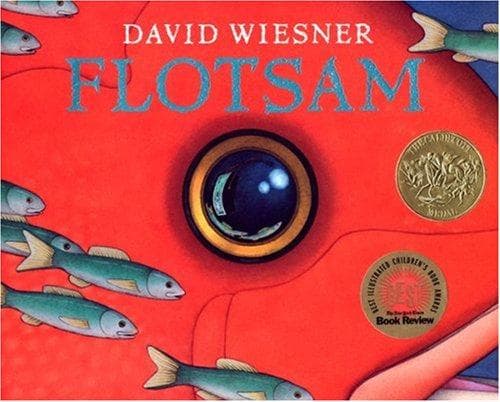
Flotsam is a wordless picture book by David Wiesner, published in 2006 and later awarded the Caldecott Medal. A boy combing a beach spots a battered underwater camera, the kind of thing the sea gives back eventually. He takes it home, and the rest of the story unfolds through pictures alone, with no text to guide you.
The art is the point. Wiesner paints in a detailed, luminous style and hides small events in the margins and background that reward a second and third look. The sequence moves from the ordinary world of a seaside town into something stranger, and shifts in scale and perspective do much of the storytelling. Children can follow it without help, while adults will notice more on repeat.
Reading it feels less like following a plot than like sorting through someone else's album. You fill the gaps yourself, deciding what happened between frames, and the book trusts you to do that. It moves quickly and can be finished in one sitting, but many readers return to catch what they missed.
Read this if you…
- value picture books for their artwork and page-by-page design
- want a wordless book to share with a child or to read slowly yourself
- enjoy piecing together a story from visual clues
Skip it if you…
- want the plot spelled out in words and dialogue
- need a clear, settled explanation at the end of every thread
Key Ideas
- 1
Looking as the main act of reading
With no words to lean on, the book asks you to read every panel closely. Faces, backgrounds, and small repeated details carry meaning, so the experience depends on how slowly and attentively you look. It is a good reminder that pictures can hold a full narrative on their own.
- 2
Found objects and the lives behind them
The story begins with an object washed ashore and imagines the people connected to it. Lost things carry traces of other times and places, and the book treats a discarded camera as a doorway rather than junk. That sense of stumbling onto someone else's history gives the book its quiet pull.
- 3
Scale and perspective as storytelling
Wiesner moves the camera's point of view around constantly, from close details to wide, dizzying views. These shifts control pacing and tension without any dialogue. Paying attention to how each page is framed shows how much craft goes into a book that looks simple at first glance.
- 4
Gaps the reader must fill
Because nothing is explained in text, the reader constructs the connections between scenes. This makes each reading slightly different and invites conversation, especially with a child. The book leaves room for your own explanations rather than insisting on one.
Limitations
The lack of text is both the book's strength and its main limitation. Some readers will find the sequence of events loose or hard to follow, and the open gaps can feel frustrating if you expect a neat resolution. Because it is a short picture book, it offers little depth for older readers looking for complexity beyond the visual puzzle. Its appeal depends heavily on patience and on enjoying ambiguity.
Questions Readers Ask
- Is Flotsam suitable for adults or only young children?
- Both. Young children can enjoy it simply as a story told in pictures, while adults often appreciate the artistry and the density of small details. Because there is no text, it works well as a shared reading experience across ages. Many adults find it more rewarding on a second or third reading.
- Do I need to read Flotsam in order, or can I skip around?
- Reading it in order is strongly recommended, since the story depends on the sequence of pictures to build momentum and connections. You can certainly revisit individual pages later to study details, but the first read works best straight through without skipping ahead.
- How does Flotsam compare to other wordless picture books?
- Flotsam is often grouped with Wiesner's other wordless books, which share a playful interest in imagination and perspective. Compared with more whimsical wordless picture books, it leans toward a quieter sense of wonder and mystery, so it suits readers who enjoy atmosphere as much as action.
- Published
- 2001
- ISBN
- 9780618194575
- Difficulty
- beginner
- Category
- Children's Books
Book details and cover from Google Books.
Ready to read Flotsam?
Get your copy on Amazon, or listen to it on Audible. We earn a commission if you buy through these links.