
We earn a commission if you buy through these links. Learn more
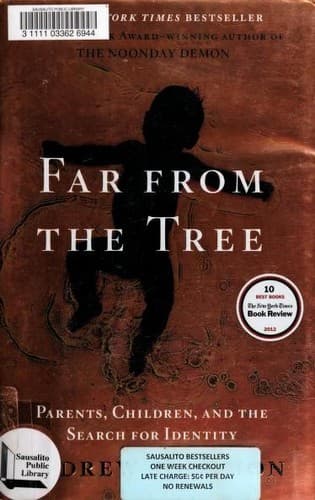
Far From the Tree
by Andrew Solomon, Andrew Solomon
Guide by the Books of the Day editors · Updated · How we write our guides
Solomon's long, humane study of families whose children differ from them in deep ways, and of how love and identity survive the gap between parent and child.
What Creators Say About Far From the Tree
1 creator reviewed Far From the Tree on YouTube in 2012, with 133.5K views between them. Their opinions are their own; we picked these reviews, we didn't write them.
What It's About
Far From the Tree is Andrew Solomon's attempt to answer a question many parents face quietly: what happens when your child turns out to be someone you did not expect. Solomon builds the book around two kinds of identity. Vertical identities are passed down from parents, such as language, religion, or nationality. Horizontal identities are learned from peers and communities, and they often diverge from the family altogether. He applies this frame to conditions and traits such as deafness, dwarfism, Down syndrome, autism, schizophrenia, disability, prodigy, and being transgender, among others.
The method is interview-driven and reportorial. Solomon spent years meeting families across these categories, and he lets parents and children speak at length, often in their own words, so the book reads as accumulated testimony rather than a single argument. Chapters move between the medical, social, and emotional sides of each situation, and he is willing to sit with the ambivalence, grief, and anger that parents sometimes feel and rarely admit.
Reading it is slow and immersive, closer to living inside a long set of case histories than to a textbook. It is emotionally demanding, and its length asks for patience. What you take away is less a set of conclusions than a wider sense of how many ways a family can struggle and succeed in loving a child who is not a copy of them.
Read this if you…
- are a parent, or expect to be one, wondering how to love a child who differs from you in a deep way
- are interested in disability, identity, or medical ethics through lived experience rather than abstract theory
- can handle long, emotionally heavy accounts and would rather have depth than a quick overview
Skip it if you…
- want a concise, practical guide to raising or treating a child with one specific condition
- prefer books that argue a single thesis tightly and move quickly from point to point
Key Ideas
- 1
Vertical and horizontal identity
The core framework separates traits inherited from parents from traits a child acquires elsewhere, through peers, community, or temperament. Most families have a sense of vertical identity, so horizontal differences can feel like a rejection even when they are not. Solomon uses this distinction to explain why some conditions strain families so differently, and it gives you a vocabulary for thinking about your own family or the people you know.
- 2
Parents learning to love a stranger
Many parents must grieve the child they expected before they can fully welcome the child they have. Solomon treats this process as real and often painful work rather than a failure of love. He shows how acceptance tends to arrive unevenly, sometimes after years, and how parents can hold love and disappointment at the same time without either cancelling the other.
- 3
Belonging outside the family
For many children with a horizontal identity, the most important community is one their parents did not choose, such as Deaf culture or a network of people with the same condition. Solomon takes these communities seriously as sources of meaning and pride. The book asks what families owe a child in finding that belonging, and how to support it without taking over the child's life.
- 4
The ethics of choice
Because many differences can now be detected before birth, the book pushes into uncomfortable territory about who gets to decide what kind of child is welcome. Solomon does not offer tidy verdicts. He presents the reasoning and feelings of people on different sides, which can make you reconsider assumptions you did not know you held.
Limitations
The book is very long and its scope is wide, so individual categories get uneven depth, and some readers find the accumulation of stories repetitive. Solomon's sources are families willing to talk, which skews toward people who have made peace with their situation or who are active in advocacy. Some readers want more analysis of clinical evidence or policy than the book provides. It also reflects the time it was researched and written, and language around disability, deafness, and gender identity has changed since then.
Questions Readers Ask
- Is Far From the Tree only for parents?
- No. Parents will likely get the most personal recognition from it, but teachers, clinicians, siblings, and anyone curious about disability and identity will find it valuable. You do not need a family connection to any of these conditions. Many readers come to it because they want to understand someone in their life better, or simply to read something that treats difference with seriousness and care.
- How does it compare to Solomon's Noonday Demon?
- Noonday Demon is centred on depression, combining personal experience with the history and treatment of the illness. Far From the Tree is more outward-facing, built on interviews with many families rather than on the author's inner life. Readers who value the thoughtfulness of one often find the other rewarding, but they are different reading experiences.
- Is it still relevant today?
- Yes, because its central questions about expectation, belonging, and love across difference have not changed. Terminology, medical understanding, and policy around disability, deafness, and gender identity have moved on, so pair it with current clinical or community sources for practical guidance. Read it for the human questions it raises, which remain as pressing as ever.
- Published
- 2012
- ISBN
- 9781481440929
- Difficulty
- intermediate
- Category
- Psychology
Book details and cover from Google Books.
Ready to read Far From the Tree?
Get your copy on Amazon, or listen to it on Audible. We earn a commission if you buy through these links.