
We earn a commission if you buy through these links. Learn more
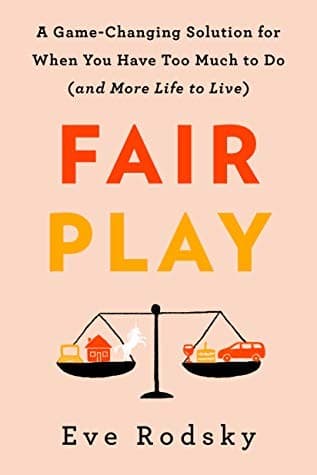
Fair Play
by Eve Rodsky
Guide by the Books of the Day editors · Updated · How we write our guides
A practical, unusually concrete answer to the unpaid mental load couples argue about, offering a card-based system for splitting not just chores but the thinking behind them.
What Creators Say About Fair Play
2 creators reviewed Fair Play on YouTube between 2019 and 2020, with 219.4K views between them. Their opinions are their own; we picked these reviews, we didn't write them.
What It's About
Fair Play is a practical guide to a problem many couples describe but few can name: the steady stream of household and family tasks that one partner tracks, remembers, and quietly carries even when the chores look shared on paper. Rodsky frames this as the mental load and argues that dividing the visible work is not enough. The thinking behind the work, including noticing what needs doing and following up, has to be shared too.
The book's method is a card-based system in which each household and caregiving task becomes a discrete card that partners sort, claim, and negotiate. The central idea is ownership: a partner who takes a task takes it from start to finish, not just the physical part. The writing is conversational and anecdote-driven, with a lot of practical scaffolding for the conversations couples often avoid having.
Reading it feels less like absorbing theory and more like sitting through a workshop with a candid, persuasive coach. It works best as a working manual. Readers tend to get the most out of it by doing the exercises with a partner rather than reading straight through, and they should expect some repetition and a brisk, self-help tone.
Read this if you…
- are in a relationship where one partner keeps running the household in their head even when chores are split
- want a concrete system and specific conversation prompts rather than general advice about communication
- are preparing for a new child, a career change, or a move and want to plan how the work will be shared
Skip it if you…
- are looking for research-heavy analysis of gender and domestic labor, since the book leans practical and anecdotal
- already share household planning well and want a deeper or more academic take on the topic
Key Ideas
- 1
The mental load is real work
Rodsky's core claim is that remembering, planning, and anticipating household needs is labor in its own right, and that it is often invisible to the person who does not carry it. Naming this as work, rather than as a personal habit or a failure to help, is what gives the rest of the argument its force. Readers who have never thought of themselves as the family's default manager will likely recognize something here.
- 2
Ownership over helping
The book distinguishes between one partner assisting with tasks on request and one partner owning a task completely. Ownership means deciding how the job gets done, when it happens, and whether it needs doing at all. Rodsky argues that assistance keeps the planning with one person, while ownership moves the whole load, which is why she treats the distinction as central rather than semantic.
- 3
Dividing tasks through a structured card system
Instead of a vague chore chart, the method breaks family life into specific tasks that can be assigned, traded, and reviewed. Making the list concrete reduces arguments about who did more, because the question becomes which cards each person holds. The system is flexible enough to work for different family structures, though it asks couples to be disciplined about maintaining it over time.
- 4
Negotiation as a skill to practice
A large part of the book is about how to start the conversation without it turning into a fight. Rodsky offers scripts, prompts, and a sense of pacing that help partners talk about fairness in terms of time, energy, and expectations. Some readers will find this the most useful section, especially if past attempts at these discussions ended badly.
- 5
Fairness measured in time and attention
Rather than aiming for an equal split of tasks by count, the book pushes couples to think about how much time and attention each job takes and who has spare capacity. This framing acknowledges that two people with the same number of chores may have very different loads. It also gives couples a shared vocabulary for revisiting the arrangement as circumstances change.
Limitations
The book is written mainly for heterosexual, dual-income couples, and its examples reflect that. It says less about single parents, households without a partner, or families with limited money, where the trade-offs look different. Structural issues such as childcare costs, workplace policies, and unpaid care for relatives get relatively little attention. Some readers find the card system labor-intensive to set up, and the self-help tone and repetition can feel padded. Its claims rest largely on the author's experience and sample rather than rigorous studies.
Questions Readers Ask
- Who is Fair Play best suited for?
- It suits couples, especially those with children, who feel that household and family planning has become lopsided even though chores appear to be divided. It is also useful for individuals who want to start a conversation with a partner. Readers who want a theoretical or academic treatment of the subject will probably find it too practical and personal in tone.
- Is Fair Play still relevant?
- Yes. The core problem of invisible planning and emotional labor remains common, and the book's emphasis on ownership and explicit negotiation still applies. Some specifics, such as examples tied to particular work arrangements, may feel dated. The underlying method does not depend on those details and can be adapted to current schedules and family structures.
- How does it compare to The Second Shift?
- The Second Shift by Arlie Hochschild is a sociological study of how working couples divide housework, based on interviews. Fair Play is a practical manual with a system and exercises. Readers who want to understand why the imbalance exists may prefer Hochschild, while readers who want to change their own household arrangements will likely find Rodsky more immediately useful.
- Published
- 2019
- ISBN
- 9780525541943
- Difficulty
- beginner
- Category
- Business
Book details and cover from Google Books.
Ready to read Fair Play?
Get your copy on Amazon, or listen to it on Audible. We earn a commission if you buy through these links.