
We earn a commission if you buy through these links. Learn more
Fahrenheit 451
by Ray Bradbury
On screen: Fahrenheit 451 (film, 1966)
Guide by the Books of the Day editors · Updated · How we write our guides
A short, fast dystopian novel about a fireman who burns books, and a sharp warning about how distraction can hollow out a culture without any censor ever needing to act.
What Creators Say About Fahrenheit 451
2 creators reviewed Fahrenheit 451 on YouTube in 2019, with 4.9M views between them. Their opinions are their own; we picked these reviews, we didn't write them.
What It's About
Fahrenheit 451 was published in 1953 and is a work of fiction, so the History category on this listing is a mismatch you should know about before you start. It follows Guy Montag, a firefighter in a future American city whose job is to burn books and the houses where they are hidden. The state never has to explain itself much. People have simply stopped reading because screens, fast entertainment and constant noise have crowded out the wish to think slowly.
Bradbury's style is lyrical and punchy at once. His sentences are vivid and often musical, with recurring imagery of fire, light, sound and glass. The story is divided into three parts and moves briskly, so it reads more like a bleak parable than a realistic novel. Characters are sketched in broad strokes, and the ideas carry most of the weight.
Reading it feels urgent and a little unsettling, more like hearing a warning than settling into a world. It is short enough that most readers finish it in one or two sittings, and it tends to stay with them long after the last page.
Read this if you…
- want a short, vivid dystopia that rewards a close reading of its imagery
- are interested in how media and distraction shape public life
- enjoy classic science fiction that uses ideas more than elaborate world-building
Skip it if you…
- need detailed characters with complex inner lives and slow emotional arcs
- expect a realistic, research-driven account of censorship or the history of book burning
Key Ideas
- 1
Entertainment as quiet censorship
The book's most unsettling move is showing that a society can lose its books without anyone banning them. When people are kept busy and comfortable, they stop wanting what books offer, and the burning becomes almost a formality. Bradbury suggests that indifference does the censor's work more efficiently than force.
- 2
Speed and surface over depth
Much of the novel is about attention: fast cars, rapid-cut entertainment, and conversation that skims without landing anywhere. Bradbury is less interested in technology itself than in what it does to patience. The book asks whether a mind trained to skim can still hold a complicated thought long enough to reach a conclusion.
- 3
Books as memory and dissent
Bradbury treats books as a form of stored human experience, a way of keeping arguments, doubts and other lives available to anyone who looks. The novel's most affecting passages turn on people who choose to carry literature in memory when paper is destroyed. It is a hopeful thread in an otherwise bleak story.
- 4
The comfort of not being challenged
A recurring question is why ordinary people accept a world that makes them less free. Bradbury points to the appeal of ease, the discomfort of disagreement, and the relief of not being asked hard questions. The book is less a story about villains than about a society that gradually stops wanting to be troubled.
Limitations
Critics often point to thin characterization. Montag and the people around him serve the argument more than they feel like fully rounded people, and some dialogue can read as a mouthpiece for the author's views. The book's anxieties about television and radio are also dated in places, since its vision of a non-reading society assumes a particular kind of mass entertainment. Some readers find the message heavy-handed. The novel is not a study of real censorship, and it does not explore how books were actually suppressed in specific historical periods.
Questions Readers Ask
- Is Fahrenheit 451 still relevant today?
- Many readers say yes, mainly because its concern is less about one medium than about attention. Debates over book bans, algorithmic feeds and constant notifications keep its questions alive. Some of its specific references to television and radio feel dated, but its core warning about being entertained into passivity still lands with readers.
- How does Fahrenheit 451 compare to Brave New World?
- Both are famous dystopias, but they warn about different dangers. Huxley imagines pleasure and conditioning producing contentment, while Bradbury imagines a culture that drifts away from books through distraction and comfort. Readers who like Fahrenheit 451 for its warning about book-burning may find Brave New World more philosophically detailed.
- Published
- 1953
- ISBN
- 9781973404439
- Difficulty
- beginner
- Category
- History
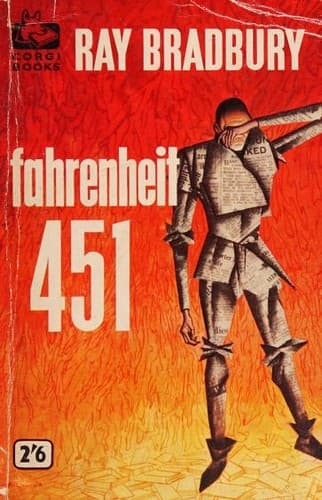
Book details and cover from Google Books.
Ready to read Fahrenheit 451?
Get your copy on Amazon, or listen to it on Audible. We earn a commission if you buy through these links.