
We earn a commission if you buy through these links. Learn more
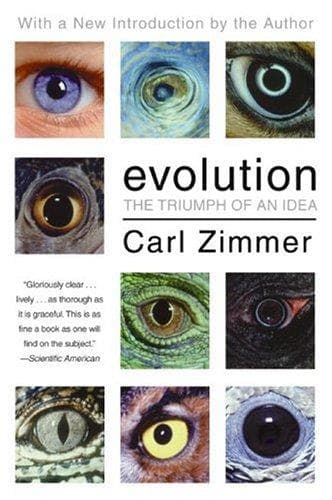
Evolution
by Carl Zimmer
Guide by the Books of the Day editors · Updated · How we write our guides
A clear, well-illustrated university-level tour of how evolution works, built around real research rather than tidy summaries, for readers ready to do the work.
What Creators Say About Evolution
1 creator reviewed Evolution on YouTube in 2010, with 263 views between them. Their opinions are their own; we picked these reviews, we didn't write them.
What It's About
This is a college-level textbook rather than a popular science book, and that shapes nearly everything about it. Carl Zimmer, a long-time science writer, wrote it with the biologist Douglas Emlen, and the two build understanding from the ground up: first the logic of natural selection and heredity, then how populations change over time, and finally how that process produces the diversity of life we see today.
The approach leans on evidence. Examples are drawn from research on fossils, genomes, and living organisms, and the authors explain how scientists reached their conclusions, including where the data are messy or the arguments remain open. Zimmer's journalist's eye shows in the readable prose and vivid case studies, while the textbook format adds figures and study aids that invite pausing to work through ideas.
Reading it feels less like being told a story and more like sitting in a well-run seminar. It rewards patience and a willingness to follow technical reasoning, especially in the genetics sections. Readers who want a short overview will find it heavy going, but anyone prepared to spend real time with it will come away with a durable, working grasp of the field.
Read this if you…
- want a serious, structured foundation in evolutionary biology rather than a single narrative
- are a student, teacher, or self-learner willing to work through figures and technical explanations
- already know the basics and want to see how the evidence is assembled
Skip it if you…
- want a narrative page-turner or a memoir-style account of scientists in the field
- are looking for a quick, light introduction you can finish in a weekend
Key Ideas
- 1
Natural selection as a testable mechanism
The book treats natural selection not as a slogan but as a set of conditions: variation, inheritance, and differential reproduction. It shows how each condition must be demonstrated and how the logic can be checked against observations in living populations. Readers learn to ask what would count as evidence against a claim, which is the central skill the book is trying to build.
- 2
Genetics as the bridge between generations
Heredity is presented as the piece that makes selection work over time. The discussion moves from classical inheritance to molecular mechanisms, showing how mutation, recombination, and drift supply the raw variation and random change that selection acts upon. Expect this section to demand concentration, since it asks readers to hold several levels of explanation at once.
- 3
Evidence from fossils, genomes, and living species
The book makes the case for common descent by combining sources that were once separate fields. Fossil sequences, comparative anatomy, and DNA comparisons are shown converging on the same family trees. Attention to how phylogenies are built and tested gives readers a working sense of why biologists trust these reconstructions.
- 4
Evolution as a framework for all of biology
The closing emphasis is that evolutionary thinking connects medicine, ecology, behavior, and conservation rather than sitting in its own corner. Examples show how a single set of ideas can illuminate many subfields. This is where the book most clearly argues that evolution is practical knowledge, not only a account of the past.
Limitations
As a textbook, it is long and dense, and its pace reflects the needs of a course rather than a casual reader's curiosity. Some readers will find the biology deeper than they need, while others will miss the personal stories of researchers that popular writers on the subject often include. Because the field moves quickly, specific findings and examples will age faster than the core principles, so newer sources are worth checking for the latest research.
Questions Readers Ask
- Is this book suitable for a general reader with no science background?
- It can be, but only with commitment. The early sections build concepts carefully, yet the book assumes you will read slowly and keep track of technical terms. A reader with some high school biology will find it manageable. Someone starting from zero may do better with a popular introduction first, then return to this for depth.
- How does it compare to a popular book on evolution?
- Popular books usually trade depth for narrative momentum, using stories to carry a single argument. This textbook works the other way, covering mechanisms, evidence, and methods systematically. If you want the big picture quickly, a trade book is the better start. If you want to understand how biologists know what they know, this is the more rewarding choice.
- Published
- 2001
- ISBN
- 9780434010264
- Difficulty
- intermediate
- Category
- Science
Book details and cover from Google Books.
Ready to read Evolution?
Get your copy on Amazon, or listen to it on Audible. We earn a commission if you buy through these links.