
We earn a commission if you buy through these links. Learn more
Everything Is Illuminated
A funny, grief-struck debut that braids a road trip through Ukraine with an invented history of a vanished Jewish town, and asks how we remember what we never saw.
What It's About
Everything Is Illuminated, Jonathan Safran Foer's 2002 debut novel, moves between three voices. A young American who shares the author's name travels to a small town in Ukraine searching for a woman who may have saved his grandfather during the Second World War. He hires Alex, a teenage translator whose English is confident and wildly off-kilter, and Alex's grandfather, who drives them through the countryside with bitter opinions and a dog of questionable pedigree. Alex writes letters to the narrator, and a third strand offers a lyrical, fabulist history of the shtetl the grandfather came from.
The style is playful and formally inventive. Alex's malapropisms turn grief into comedy, then sometimes turn comedy back into grief, often within a single paragraph. The invented history is rich and magical, shaped by family legend, while the American narrator's sections are more self-conscious and uncertain. Photographs and unusual typography appear along the way. Reading it feels like moving between laughter and sorrow, and then trying to assemble a puzzle whose pieces disagree with each other.
At its heart, this is a book about how the past is reconstructed from fragments, and how a person can feel deep attachment to a place known only through other people's stories. It rewards close attention and a willingness to be disoriented.
Read this if you…
- Want a novel that mixes humor and heartbreak without settling into either
- Are interested in how Holocaust memory passes between generations
- Enjoy formally playful fiction where the structure is part of the meaning
Skip it if you…
- Prefer straightforward plots and a single, steady narrative voice
- Find broken-English comedy tiresome or uncomfortable
Key Ideas
- 1
Memory as reconstruction from fragments
The narrator knows his family's history mainly through hearsay, half-remembered anecdotes, and a few objects. The book keeps showing how much of what we call history is assembled from partial accounts, and how each retelling bends the facts a little further.
- 2
Comedy and catastrophe in the same voice
Alex's letters are often hilarious because his English misfires so charmingly. Foer lets that humor sit right beside violence, loss, and resentment, so the reader never gets comfortable and is repeatedly reminded of what the jokes are standing in front of.
- 3
Inherited trauma and the stories families tell
The grandfather's rage and the narrator's need to find an answer both show how the Holocaust shapes people who never lived through it. The novel asks what it means to inherit a wound and a debt without inheriting the full story behind them.
- 4
A vanished world rebuilt through invention
The Trachimbrod sections are a deliberately fanciful account of a Jewish village and its generations, full of legend and magical detail. Foer uses invention not to replace the real destruction but to show how imagination is one of the few ways to honor a lost place.
- 5
Form that mirrors uncertainty
The shifting narrators, mismatched tones, and visual elements are not decoration. They make the reader feel the gaps between what people know, what they claim to know, and what they only wish were true.
Limitations
Some critics find the postmodern tricks showy, and the novel's self-awareness can feel like it is performing its own cleverness. Alex's voice is the book's most discussed element, and some readers find the comedy at his expense uneasy. The Trachimbrod sections can read as overwritten or overly whimsical next to the grim subject. The Holocaust is approached obliquely rather than directly, which some readers see as a strength and others as a limit. The ending divides readers, and the novel does not offer the closure many expect.
Questions Readers Ask
- Is Everything Is Illuminated based on a true story?
- It is a work of fiction. The narrator shares the author's name and the search is a fictional device, but the book draws on real history of Jewish life in Eastern Europe and the Holocaust. It should be read as an invented account rather than a memoir or documentary record.
- How does it compare to Foer's later novel Extremely Loud & Incredibly Close?
- Both use playful typography and a child or young narrator grappling with loss, but this debut is looser, more comic, and more experimental in form. Extremely Loud is more emotionally direct and more conventional in structure, so readers who want a steadier narrative may prefer it.
- Is it still worth reading in 2024?
- Yes. Its questions about memory, inheritance, and how we understand history remain current, and it is a strong example of early 2000s experimental fiction. Some of its humor and self-conscious tricks may feel dated to some readers, but the emotional core still lands.
- Published
- 2002
- ISBN
- 9783596156283
- Difficulty
- intermediate
- Category
- Fiction
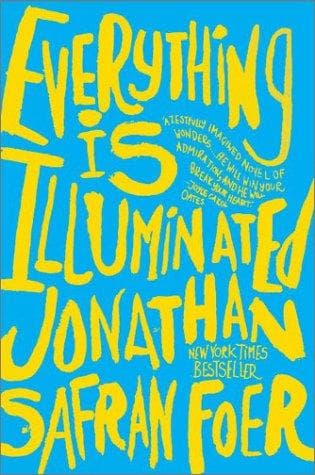
Book details and cover from Google Books.
Ready to read Everything Is Illuminated?
Get your copy on Amazon, or listen to it on Audible. We earn a commission if you buy through these links.