
We earn a commission if you buy through these links. Learn more
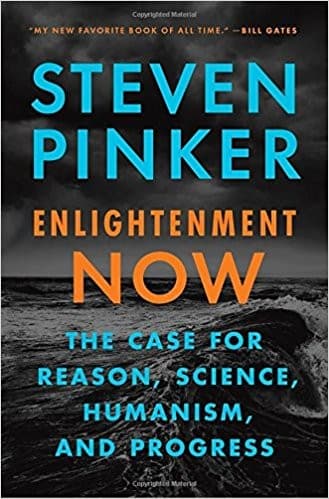
Enlightenment now
by Steven Pinker, Pablo Hermida Lazcano
Pinker's data-heavy case that life has improved on most measures, and a clear defense of reason and science as the reasons why.
What It's About
Steven Pinker's 2018 book makes one central claim: by most measures of human welfare, the world has improved dramatically over the last two centuries, and the people most inclined to gloom are often the least aware of it. He builds this case with a long run of graphs covering life expectancy, child mortality, poverty, literacy, war deaths, and more. Much of the book is an argument about why the trends happened, and Pinker credits the ideas of the Enlightenment: reason, science, humanism, and progress.
The style is that of a professor who enjoys data and argument. Pinker writes in a brisk, conversational voice, leans heavily on charts, and anticipates objections. The early sections establish the trends; later ones defend the values behind them and attack what he sees as their rivals, from anti-scientific romanticism to tribal politics and fashionable pessimism. The chapters are topical rather than chronological, so you can follow the argument as a series of related claims, each propped up by a dense pile of numbers.
Reading it feels less like being lectured about injustice and more like being asked to check your assumptions. It is optimistic, combative at times, and often funny in its asides. It will leave many readers with a clearer sense of what has improved and a stronger suspicion of alarming headlines. It may also leave some feeling that the author argues his case with more confidence than the evidence always allows.
Read this if you…
- want a well-sourced counterweight to the idea that the world is getting steadily worse
- enjoy arguments built from long data series and are happy to skim or question the charts
- are interested in how Enlightenment ideas connect to modern science, medicine, and public policy
Skip it if you…
- want a book centered on inequality, colonial history, or who has been left behind by progress
- find confident, sweeping optimism tiring when it runs into real political and environmental problems
Key Ideas
- 1
Measuring progress across many human dimensions
Pinker's central method is to line up long time series for health, wealth, safety, and knowledge, and show that most have moved in the right direction since the eighteenth century. The strength of the book is the sheer breadth of these measures. Its argument depends on the reader accepting that the trends are real and not artifacts of how they were counted.
- 2
Enlightenment values as the source of improvement
Pinker argues that reason, science, humanism, and a belief in progress are not just pleasant ideals but the working causes behind the gains. He traces how these commitments shaped medicine, government, and the treatment of individuals. Readers who expect a purely statistical book will find a good deal of intellectual history and moral philosophy here.
- 3
Why pessimism feels more convincing than the data
A substantial part of the book explains why people underrate progress. Pinker discusses negativity bias, the way news favors dramatic failures, and the appeal of narratives about decline. He treats these as psychological and media habits rather than reasons to think things are getting worse, and this section tends to be the most persuasive for general readers.
- 4
Defending reason against its modern critics
Pinker spends real effort on intellectual movements he considers hostile to reason, including some strands of postmodern thought, romantic nostalgia, and religious and political tribalism. Some readers will find these chapters bracing and well argued. Others will feel they are fighting positions that are caricatured or hard to pin down.
- 5
Existential risks and the case for continued progress
The closing sections turn to threats such as nuclear weapons, pandemics, climate change, and emerging technologies. Pinker argues that these are serious problems that can be solved through the same tools that produced past gains. This part connects the historical record to present choices, though its treatment of risk is brief compared with the data-driven chapters.
Limitations
Critics have argued that the book leans on averages and long-run aggregates that can hide suffering, inequality, and regional setbacks. Some economists and historians have questioned particular charts, baselines, and the choice of starting dates. Pinker's portrait of the Enlightenment is also contested, since it presents a tidy set of ideas that some historians see as more varied and conflicted. Readers should treat the trends as a serious starting point while checking the sources behind them.
Questions Readers Ask
- Is Enlightenment Now still relevant today?
- Yes, mostly for its argument and its method. The specific statistics date from the late 2010s and have been updated by others, but the central question of how to judge progress and why pessimism spreads remains live. Readers today often use it as a starting point for debates about trends in health, violence, and poverty.
- How does it compare to Factfulness by Hans Rosling?
- Both books argue that the world is better than many people assume and that our instincts about it are often wrong. Rosling's book is more practical and quizzes readers on their assumptions, while Pinker's is longer, more argumentative, and more interested in philosophy. Readers who want a quick, friendly introduction may prefer Rosling, and those wanting a deeper defense of Enlightenment ideas may prefer Pinker.
- Published
- 2018
- ISBN
- 9780525529774
- Difficulty
- intermediate
- Category
- History
Book details and cover from Google Books.
Ready to read Enlightenment now?
Get your copy on Amazon, or listen to it on Audible. We earn a commission if you buy through these links.