
We earn a commission if you buy through these links. Learn more
Ender's Game
Guide by the Books of the Day editors · Updated · How we write our guides
Ender's Game is a sharp, fast military science fiction novel that uses a gifted child's training to ask hard questions about war, power, and what adults owe the young.
What Creators Say About Ender's Game
2 creators reviewed Ender's Game on YouTube between 2014 and 2021, with 54.4K views between them. Their opinions are their own; we picked these reviews, we didn't write them.
What It's About
Ender's Game is a 1985 science fiction novel by Orson Scott Card. After an earlier war with an insectoid alien species nearly destroyed humanity, the military begins recruiting gifted children to train as future commanders. The story follows Andrew "Ender" Wiggin, one of the most promising of these recruits, as he is sent to Battle School, an orbital station where children are pushed through games of strategy and combat while the adults running the program watch closely for talent and weakness.
The book is tight and propulsive. Card writes in close third person from Ender's point of view, so you feel the isolation, pressure, and small social battles of a child living among other children who are also trying to get ahead. Much of the pleasure comes from the battle-game sequences, which are clear enough that you can follow the tactics without any military background.
The experience is less about spaceships than about what it costs to lead at a young age. The novel keeps asking how much an adult system should be allowed to take from a child, and it is unsettled by how easily that system takes it. It reads quickly and emotionally, and many readers finish it in a weekend and then spend longer arguing about what it meant.
Read this if you…
- enjoy military science fiction focused on people more than hardware
- want a fast read that raises real questions about war and leadership
- are curious about how gifted children are treated by the systems that claim to develop them
Skip it if you…
- want an action-heavy space opera with large battles and little interiority
- need the characters' psychology and dialogue to feel fully adult and naturalistic throughout
Key Ideas
- 1
Children shaped by adult systems
The core tension is between a child's own wishes and the goals of institutions that see him as a resource. Card shows how training, testing, and isolation can be presented as care while functioning as control. The book is most useful as a lens for thinking about how any system handles young people with exceptional ability.
- 2
Empathy as a weapon and a burden
Ender is valued for his skill at understanding opponents, which makes him an effective strategist. The same trait makes the violence he is asked to commit harder to bear. The novel treats understanding an enemy as both a tactical advantage and a source of moral strain, and it does not let either side of that idea off easily.
- 3
Strategy as the central pleasure
Battle School's games are where the book's ideas about leadership become concrete. Readers who enjoy watching a mind work through a problem under pressure will find the tactical scenes satisfying. The strategy is presented in plain language, so the appeal is in following the logic rather than mastering technical detail.
- 4
Family bonds under pressure
Ender's relationships with his siblings run alongside his training and give the story its emotional stakes. These bonds show what he stands to lose and why the institutions around him are so willing to isolate him. The family thread is a steady counterweight to the cold logic of the military setting.
Limitations
The prose is clean but plain, and some readers find the child characters talk and think more like idealized adults than real children. The gender roles and the handling of female characters feel dated to many modern readers. Card's public statements on social issues in later years have made the book and its author a source of controversy, and some readers want to separate the work from those views while others will not. The novel also gives its alien enemy little real presence, so readers looking for a richly imagined other species may be disappointed.
Questions Readers Ask
- Is Ender's Game suitable for teenagers?
- Yes, it is widely read by teenagers and is often assigned in schools. It contains childhood violence in the training scenes and some dark themes about manipulation, so parents may want to read it first for younger children. Its ideas about power and moral responsibility tend to suit readers in their early teens and up.
- Is Ender's Game still relevant today?
- Its central questions about how societies use young people, how leaders handle propaganda, and what war does to individuals remain current. Some of the technology and social assumptions feel old, but the emotional and ethical core still holds up well for new readers.
- How does it compare to The Hunger Games?
- Both feature young people trained for brutal conflict run by cold institutions. Ender's Game is more focused on strategy and the psychology of command, while The Hunger Games centers on survival and spectacle. Readers who liked the moral pressure of one often find the other engaging for similar reasons.
- Published
- 1985
- ISBN
- 9780613824224
- Difficulty
- beginner
- Category
- Education
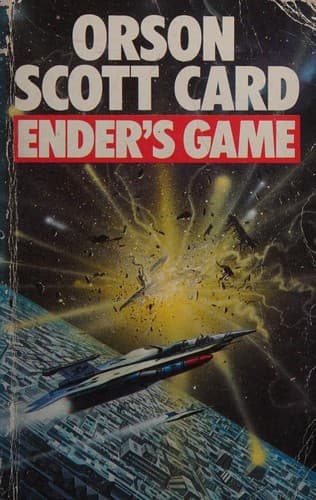
Book details and cover from Google Books.
Ready to read Ender's Game?
Get your copy on Amazon, or listen to it on Audible. We earn a commission if you buy through these links.