
We earn a commission if you buy through these links. Learn more
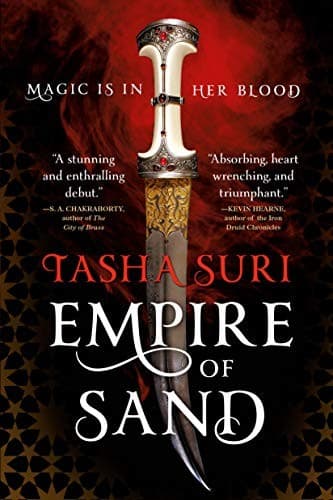
Empire of sand
by Tasha Suri
Empire of Sand is a Mughal-inspired fantasy about a woman hiding a dangerous magic inside an empire that punishes it, with politics and romance that carry real weight.
What It's About
Empire of Sand is a fantasy novel set in a world modeled loosely on Mughal India, where an imperial state has long controlled a people whose magic is treated as a threat. The story follows Mehr, a young woman whose gift for shaping the world around her is something she has learned to conceal, while living in a household with its own reasons for caution. When her secret begins to surface, her choices become tangled with a larger struggle over who holds power and who pays for having it.
Tasha Suri writes in a dense, sensory prose style, paying close attention to architecture, clothing, food, and ritual. This makes the imperial court feel lived in rather than decorative. The pacing leans toward character and political maneuvering as much as action, so much of the book is spent inside Mehr's head as she weighs loyalty against self-preservation. The romance is part of the story and carries genuine emotional stakes rather than serving as decoration.
Reading it feels like sinking into a long, immersive world rather than skimming a quick adventure. It rewards readers who are happy to live with ambiguity and let the magic and the politics unfold gradually. Expect a slower build in the early chapters before the tension tightens.
Read this if you…
- want immersive fantasy with a strong political undercurrent
- enjoy slow-building character drama with a romantic thread
- want fantasy drawn from South Asian history and culture rather than medieval Europe
Skip it if you…
- want fast plot momentum and frequent action set pieces
- prefer clear-cut heroes and villains with no moral grey areas
Key Ideas
- 1
Magic as an inherited danger
Mehr's gift is not a source of pride but a liability that could get her killed. Hiding it becomes a daily discipline, and the book uses that secrecy to explore how identity is shaped when being yourself is risky. Much of the emotional tension comes from her constant calculation about who might discover what she can do.
- 2
The cost of belonging to an empire
The empire asks its subjects to assimilate, comply, and quietly accept their place. Suri examines how such systems work through fear, privilege, and small compromises, and how people are drawn into participating in the very structures that oppress them. The book is less interested in cartoonish tyrants than in how ordinary complicity keeps power intact.
- 3
Divided loyalties with no clean side
Mehr is pulled between family, her own survival, and the people her gift could help or harm. The story refuses to make her choices easy or obviously righteous. Readers who like protagonists whose decisions carry real moral cost will find a lot here to chew on.
- 4
World-building through texture and ritual
The setting is built through the details of court life, religious practice, domestic routines, and the aesthetics of power. Rather than long info-dumps, the reader absorbs the world gradually through what characters notice and take for granted. This sensory approach is one of the book's main strengths and a clear reason many readers single it out.
- 5
Desire and trust under surveillance
The romantic thread is entangled with danger, since trusting someone can expose a secret or betray a side. Suri uses intimacy to test characters' loyalties and to show how hard it is to be vulnerable in a watched society. The relationships feel like they matter because the stakes are real.
Limitations
The first part of the book moves slowly, and some readers find the early stretches heavy on setup before the story gathers pace. The magic system is revealed gradually, which some find satisfying and others find vague. The romance follows familiar genre patterns, and a few readers feel the political plotting is less sharp than the atmosphere. Because it is the first book of a duology, the larger story continues in the sequel and does not fully close here. The setting is a reimagining rather than historical fiction, and readers with deep knowledge of Mughal history may have views on how it adapts that material.
Questions Readers Ask
- Is Empire of Sand the first book in a series?
- Yes, it is the first book of a two-book story, continued in Realm of Ash. The first book has its own arc and gives a satisfying reading experience, but it leaves major threads open. If you enjoy the story, plan on reading the sequel to get the full picture.
- Do I need to know Mughal history to enjoy it?
- No. The book is a fantasy with invented names, places, and a magic system, and it stands on its own. Some background in Mughal India will add to the texture of the court scenes and the politics, but readers without that knowledge still follow the story and its themes without difficulty.
- Published
- 2018
- ISBN
- 9781549176777
- Difficulty
- intermediate
- Category
- Fiction
Book details and cover from Google Books.
Ready to read Empire of sand?
Get your copy on Amazon, or listen to it on Audible. We earn a commission if you buy through these links.