
We earn a commission if you buy through these links. Learn more
Empire of liberty
Guide by the Books of the Day editors · Updated · How we write our guides
A wide-ranging, argument-driven account of how the young American republic grew more democratic, commercial, and expansive than its founders planned, from 1789 to 1815.
What Creators Say About Empire of liberty
1 creator reviewed Empire of liberty on YouTube in 2013, with 1.1K views between them. Their opinions are their own; we picked these reviews, we didn't write them.
What It's About
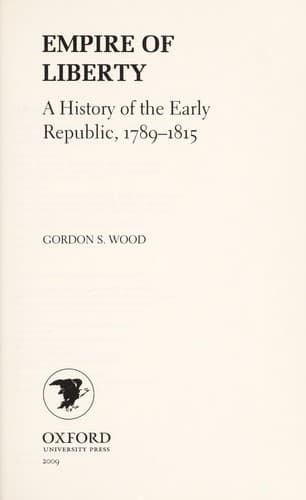
Empire of Liberty is the fourth volume of the Oxford History of the United States and covers the republic's first generation, from Washington's inauguration in 1789 through the aftermath of the War of 1812. Gordon S. Wood, a historian at Brown University known for his work on the American Revolution, treats these decades as one connected story rather than a string of presidencies. His central question is how a small, wary, mostly agrarian nation under a new constitution became something more democratic, more commercial, and more expansive than its leaders intended or expected.
The approach is narrative and interpretive. Wood moves between Congress, the presidency, the courts, state politics, the press, and the frontier, and he pays close attention to the political culture that made partisan conflict possible. He cares more about ideas, rhetoric, and unintended consequences than about battles or biography for their own sake, so readers hoping for a dramatic, character-driven chronicle may find the book cerebral. The prose is clear and often wry, and the chapters reward slow reading.
Reading it feels like being walked through a long argument by someone who has thought about it for decades. You come away with a sharper sense of why the Federalists lost ground, what Jefferson's vision of an expanding republic actually asked of citizens, and how the question of slavery ran beneath nearly every decision. It is a substantial book, best approached with patience and some prior familiarity with the period.
Read this if you…
- want a serious, interpretive account of how early American politics actually worked
- are curious how the first parties formed and why the Federalists collapsed
- already know the Revolution and want to understand what came after it
Skip it if you…
- want a fast-paced narrative built around individual characters and battles
- are looking for a detailed social history of enslaved people, women, or Native Americans
Key Ideas
- 1
Democratization as the defining change
Wood's main thread is that the Revolution released a wave of popular participation that the founders found alarming. By the early 1800s, politics was openly partisan and organized around voters rather than gentlemen deferring to one another. The book treats this shift as the most important long-term development of the era, and it asks readers to see the rise of party politics as a real change in how Americans understood authority.
- 2
Jefferson's empire of liberty
Jefferson believed a republic of independent farmers could survive only if it kept expanding west. Wood examines how this idea shaped the Louisiana Purchase and westward settlement, and he shows that the vision depended on displacing Native peoples and on the labor of enslaved people. The phrase is less a boast than a strategy, and the book explores how it worked in practice.
- 3
The Federalists and their decline
Hamilton's financial program built a durable national government, but the Federalists struggled to speak to a growing electorate and leaned on elite assumptions about who should rule. Wood traces how policies such as the Alien and Sedition Acts damaged the party's standing. His account explains why a movement that built much of the early state could lose its hold on power so quickly.
- 4
Slavery as the unresolved contradiction
The language of liberty sat uneasily beside the enslavement of hundreds of thousands of people, and the book keeps this tension in view rather than treating it as a side issue. Expansion into new territory made the question more urgent, and Wood shows how political leaders often postponed it. Readers who want a full account of enslaved people's lives will need other sources, but the political stakes are well drawn here.
- 5
Outcomes that leaders did not intend
A recurring lesson is that the republic's trajectory often diverged from what its leaders hoped. Measures designed to restrain popular politics sometimes accelerated it, and disputes over foreign policy reshaped domestic parties. Wood's interest in unintended consequences gives the book a reflective tone, encouraging readers to question tidy stories about the founders carrying out a plan.
Limitations
Critics note that Wood's focus stays mostly on political leaders, elites, and the national government, so ordinary farmers, workers, women, and Native and enslaved people appear mainly as forces shaping elite decisions rather than as full historical actors. Some reviewers also argue that the book's account of democratization can read as a steady march toward modern politics, underplaying conflict and contingency. Its interpretive emphasis means it is not a neutral survey of events, and readers wanting a broad chronological narrative may need to supplement it with other histories.
Questions Readers Ask
- Who is Empire of Liberty best for?
- It suits readers who already know the basics of the American founding and want a deeper look at the decades after the Constitution. General readers with an interest in politics will find it rewarding, though it demands sustained attention. Students of American history will find it a standard reference point for this period, and it works well alongside more narrative accounts.
- Is the book still relevant to current debates?
- Yes. Its questions about party conflict, the scope of federal power, and the tension between expansion and democratic ideals still resonate. Wood's arguments are interpretive rather than final, so it is worth reading alongside newer scholarship on slavery, Native history, and the early economy, which have shifted emphasis since the book appeared.
- Published
- 2009
- ISBN
- 9780199832460
- Difficulty
- intermediate
- Category
- History
Book details and cover from Google Books.
Ready to read Empire of liberty?
Get your copy on Amazon, or listen to it on Audible. We earn a commission if you buy through these links.