
We earn a commission if you buy through these links. Learn more
Empire of cotton
Sven Beckert shows how cotton linked slavery, empire, and factories into one global system, changing how you see the Industrial Revolution.
What It's About
Empire of Cotton is a global history of capitalism told through a single commodity. Beckert starts well before the factory era, tracing cotton from its ancient cultivation and trade in South Asia through the medieval and early modern world, and then follows it into the nineteenth century, when it became the raw material of the first mass industry. The book's central move is to treat cotton not as a backdrop to the Industrial Revolution but as one of its engines, and to show how much of the world had to be reorganized to make cloth cheap enough to sell everywhere.
The approach is sweeping but grounded. Beckert moves between fields in West Africa, plantations in the American South, Indian weaving communities, Lancashire mills, and colonial offices in London and Calcutta, so the reader keeps seeing how the same fibre connects distant lives. The prose is clear and argumentative rather than ornamented, and the narrative is driven by a series of large claims that the chapters test against concrete episodes.
The experience is sobering. Much of the story concerns coercion, forced labour, and dispossession, and Beckert is direct that these were not side effects of free markets but part of how those markets were built. It is a book that asks you to reconsider familiar stories of progress, and it rewards patience from readers who are not already specialists in economic or imperial history.
Read this if you…
- want a global view of the Industrial Revolution instead of a Britain-centred one
- are interested in how slavery and empire were tied to modern economic growth
- enjoy big-picture economic history that still anchors its argument in specific people and places
Skip it if you…
- want a short, lively narrative with a single protagonist or a fast-moving story
- are mainly interested in fashion, textile design, or the consumer culture of clothing
Key Ideas
- 1
Cotton as an engine of industrial capitalism
Beckert argues that cotton was the first commodity whose production had to be scaled across the globe to feed mechanized manufacturing. The Industrial Revolution in Britain therefore rested on raw material systems stretching far beyond Europe, and understanding it means looking at those distant fields and labour arrangements.
- 2
War capitalism and the role of coercion
The book uses the term war capitalism for the period when merchants and states organized production through force, including slavery, forced cultivation, and seizure of land and labour. Beckert presents this coercive phase not as a prelude to free markets but as a necessary part of how they took shape.
- 3
How states and empires shaped the market
Markets for cotton were built by colonial administrations, tax systems, and state-backed merchant networks rather than emerging through spontaneous exchange. The book shows how power and commerce were intertwined, which challenges the idea that capitalism grew mainly out of voluntary trade.
- 4
Shifting global balance in cloth production
The book traces how South Asian weavers were once dominant producers and how their position changed as British industry rose and imported cloth displaced local production. It offers a longer view of how the global hierarchy of manufacturing was reshaped over a few generations.
Limitations
A common objection is that the book's synthesis is so ambitious that individual regions receive less depth than specialists would like, and readers relying on it alone may come away with a tidier picture than the scholarship supports. Because the focus stays on production and trade, the everyday experience of workers, consumers, and cultural change gets less attention. Its framing of capitalism's violence is deliberately strong, and some readers find the thesis broad. Written over a decade ago, it does not capture every later development in research on slavery and South Asian textiles.
Questions Readers Ask
- Is Empire of Cotton a good first book on global economic history?
- Yes, for most general readers it works well as an introduction. Beckert explains the economic concepts he uses and keeps returning to concrete places and people. Some familiarity with the Industrial Revolution helps, but it is not required, and the book gives you a useful framework for later reading.
- How does it compare to Kenneth Pomeranz's The Great Divergence?
- Both books challenge Eurocentric accounts of industrialization. Pomeranz focuses on why Europe and China diverged economically, while Beckert uses one commodity to tie together Europe, Africa, America, and South Asia. If you want a single thread through the global story, Beckert is the more accessible choice.
- Is the book still relevant today?
- Yes. Its argument about how global supply chains, coercion, and state power shaped modern manufacturing still informs discussions of trade and labour. Some of the specific research has been extended since publication, but the book's central framing remains a common reference point in economic history.
- Published
- 2004
- ISBN
- 9780141979977
- Difficulty
- intermediate
- Category
- History
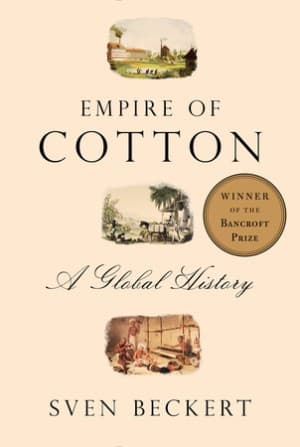
Book details and cover from Google Books.
Ready to read Empire of cotton?
Get your copy on Amazon, or listen to it on Audible. We earn a commission if you buy through these links.