
We earn a commission if you buy through these links. Learn more
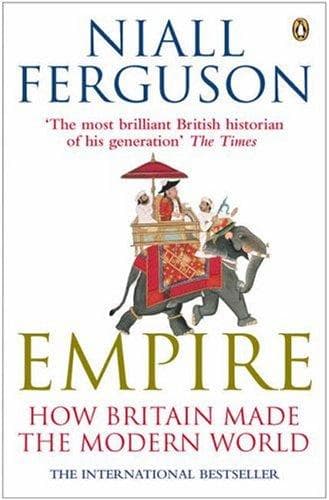
Empire
A provocative, sweeping case that the British Empire was a major engine of the modern world, worth reading for its argument and for what it reveals about today's debates over American power.
What It's About
Empire: How Britain Made the Modern World is a narrative history of the British Empire from its early overseas ventures through its decline in the twentieth century. Niall Ferguson sets out to argue a provocative position: that the empire was, on balance, a force for good and a major engine of globalization. He moves quickly across continents, from North America and the Caribbean to India, Africa, and Asia, tracing how a small island came to govern a large share of humanity.
The style is brisk, vivid, and openly opinionated. Ferguson leans on anecdote, memorable personalities, and punchy comparisons, and he is comfortable making sweeping judgments. Reading it feels closer to a long, argumentative essay than an encyclopedic survey. You come away with a clear thesis to agree with or push against, and a strong sense of how trade, finance, religion, engineering, and government fit together.
Expect a book that rewards engagement rather than passive acceptance. Some readers will find its energy persuasive; others will feel its verdicts outrun the evidence. Either way, it works as a provocation, pushing you to consider what empire meant from the inside and what the word still implies about the present day.
Read this if you…
- want a big-picture narrative of Britain's global reach in a single volume
- enjoy a strongly argued thesis and want to test it against the evidence
- are interested in how the British Empire connects to current debates about American power
Skip it if you…
- want a balanced account centered on the experiences of colonized peoples
- prefer detailed archival scholarship or regional deep dives over sweeping synthesis
Key Ideas
- 1
Empire as a globalizing force
Ferguson's central claim is that Britain's imperial network moved people, capital, goods, and ideas across the world on an unprecedented scale. He treats the empire less as conquest alone than as an early model of integrated global markets, and argues that the connections it built outlasted its flag.
- 2
Six institutions Britain exported
He credits a set of institutions and habits that Britain carried abroad, including competition, science, property rights, medicine, consumer society, and a work ethic. Ferguson presents these as reasons the British model spread and outcompeted rivals, and he uses them as a lens for judging the empire's record.
- 3
Ruling with a small footprint
Ferguson stresses how thinly Britain governed vast populations, relying on local elites, collaborators, and naval and financial power more than on large numbers of British personnel. This lets him argue the empire rested on consent and self-interest as much as force, a point central to his defense and disputed by critics.
- 4
Decline and the American question
He traces how the imperial system weakened through war, debt, and nationalism, and draws explicit parallels to the United States, arguing that America faces similar choices about its own global role. These parallels shape much of the book's contemporary relevance and the debate around it.
Limitations
The book's favorable verdict on empire is its most contested feature. Critics argue that Ferguson underplays the violence, extraction, famine, and racial hierarchy that were integral to imperial rule, and that his evidence often comes from the perspective of administrators and beneficiaries. Its comparisons to the United States were also read as polemical, especially after the Iraq War. Published in 2002, it predates a good deal of later scholarship on colonial history, so it should be read alongside newer work.
Questions Readers Ask
- Is Empire by Niall Ferguson still worth reading?
- Yes, especially if you want to understand the argument that empire drove globalization and that the United States might follow a similar path. Its central claim is still debated. Pair it with more recent histories that focus on colonial violence and the experiences of colonized people to get a fuller picture.
- How does it compare to Jan Morris's Pax Britannica?
- Morris writes with more literary flair and a more personal, impressionistic style, and her trilogy is less interested in arguing a single thesis. Ferguson is more analytical and polemical, organizing the story around a clear claim. If you want atmosphere and narrative color, Morris suits you better; if you want a debate you can push against, Ferguson does.
- Published
- 2003
- ISBN
- 9780141804019
- Difficulty
- intermediate
- Category
- History
Book details and cover from Google Books.
Ready to read Empire?
Get your copy on Amazon, or listen to it on Audible. We earn a commission if you buy through these links.