
We earn a commission if you buy through these links. Learn more
Emma
by Jane Austen
On screen: Clueless (film, 1995)
A witty comedy of manners about a clever young woman certain she reads other people's hearts better than her own, and the lesson she has to learn about it.
What It's About
Emma is Jane Austen's 1815 novel about Emma Woodhouse, a handsome, clever, and wealthy young woman who lives with her anxious, fussing father in the village of Highbury. With little to do and a high opinion of her own judgement, she takes on the project of arranging other people's romantic lives, beginning with a pleasant but socially uncertain young friend. The book stays almost entirely inside a small circle of neighbours, with its plot built from visits, dinners, walks, and misjudged conversations rather than large events.
Austen's method is comedy of manners. The narration stays close to Emma's thinking and lets the reader notice her errors a little before she does, so you are often ahead of the heroine and enjoying the gap. The dialogue is the real engine. Much of the pleasure lies in small exchanges where people say one thing and mean another, and in the careful politeness of a community where everyone watches everyone else and keeps score.
Reading it feels unhurried and conversational, more like sitting in on a social circle than following a plot. The early chapters can seem slow to readers used to fast fiction, but the pace tightens as the misunderstandings compound and the characters' real feelings become harder to hide. It rewards close attention, and many readers find it even sharper on a second reading.
Read this if you…
- enjoy sharp dialogue and social comedy
- like heroines whose flaws drive the story
- want a classic that rewards slow, attentive reading
Skip it if you…
- need fast plot momentum or constant action
- want a modern setting with contemporary characters and voices
Key Ideas
- 1
Confidence that outruns self-knowledge
Emma's central problem is that she is sure of her judgement and rarely examines it. The novel is less interested in whether she is clever than in how easily cleverness becomes a blind spot when nobody challenges you. Watching her misread the people around her is the book's main source of both comedy and unease.
- 2
Marriage, money, and social standing
Every romantic plan in the book is shaped by rank, fortune, and reputation. Austen treats matchmaking as a serious business for women with limited options, even while she mocks the people who take it too lightly. The stakes feel small on the surface but are very real to the characters.
- 3
Talk as a way to hide and reveal
Conversation in this novel is a form of social manoeuvring. Characters flatter, deflect, and speak in half-sentences, and the reader has to work out what they actually mean. Austen's ear for this kind of polite evasion is one of the reasons the book still reads so freshly.
- 4
Gentle satire of a small world
Highbury is a closed community where gossip, habit, and invalid-like anxieties shape daily life. Austen satirises its routines with affection rather than contempt, so the village feels comic and sometimes touching rather than simply foolish. The narrowness of the setting is part of the point.
Limitations
The book is almost entirely about a narrow group of well-off country families, so servants, the working poor, and the wider world appear only at the edges. Its marriage plot can feel conventional to readers who want more surprise or a darker edge. The prose is formal and full of long, balanced sentences, which can take some getting used to. Some readers also find Emma's treatment of Harriet Smith and Miss Bates uncomfortable to watch, though that discomfort is arguably deliberate.
Questions Readers Ask
- Is Emma a good first Jane Austen novel?
- It can be, but many readers start with Pride and Prejudice because its heroine is more immediately appealing. Emma is more concentrated on one character's blind spots and asks you to stay with her through her mistakes. If you enjoy comedy of manners and can tolerate a slower opening, it works well as a first book by her.
- How does Emma compare to Pride and Prejudice?
- Pride and Prejudice has more romantic momentum and a warmer, more likeable central pair. Emma is quieter and more focused on social observation, with a protagonist who is harder to like at first. Readers who love the wit of Pride and Prejudice often find Emma richer on a reread, though it is less bright on the surface.
- Published
- 1815
- ISBN
- 9780395051153
- Difficulty
- intermediate
- Category
- Fiction
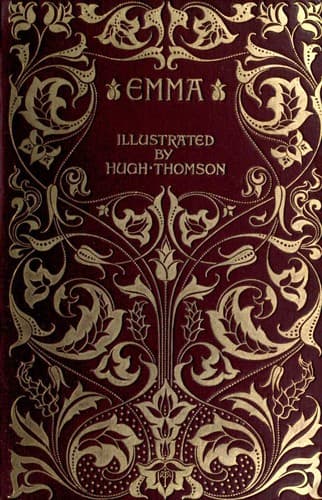
Book details and cover from Google Books.
Ready to read Emma?
Get your copy on Amazon, or listen to it on Audible. We earn a commission if you buy through these links.