
We earn a commission if you buy through these links. Learn more
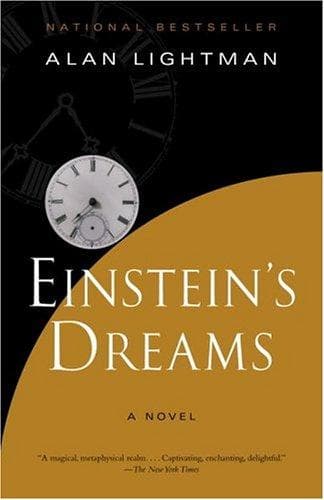
Einstein's dreams
A short, quiet novel that turns Einstein's 1905 year into a set of thought experiments about what time might be, and what it does to ordinary human lives.
What It's About
Einstein's Dreams is a short novel published in 1992 that imagines the spring of 1905, when a young patent clerk in Bern, Switzerland, was working out ideas that would reshape physics. Alan Lightman wraps that historical setting around a series of brief dream-vignettes, each describing a different possible world in which time behaves in some unfamiliar way. In some worlds time loops back on itself, in others it freezes, and in others people live by clocks that run at different speeds depending on where they are.
The individual pieces are often only a page or two long, written in a calm, precise, fable-like voice. Lightman avoids equations and technical detail. He uses plain images and parables to ask what time means to daily life: memory, work, love, aging, regret, and the pull of schedules. The passages about Einstein himself are sparser. They show a man absorbed in thought, restless with routine, and close to a few friends, which gives the dreams a human frame without turning the book into a biography.
Reading it feels more like sitting with a collection of meditations than following a plot. It is quick, quiet, and thought-provoking, and it rewards slow reading and rereading. Readers who want a driving narrative or deeply drawn characters will find it thin, but those who enjoy ideas presented as small, self-contained puzzles will likely find it memorable.
Read this if you…
- are curious about relativity but want the ideas without equations
- enjoy short, poetic fiction you can read in small sittings
- like philosophical stories that leave you reflecting on your own days
Skip it if you…
- want a plot with characters you follow through conflict and change
- need accurate science or a detailed biography of Einstein
Key Ideas
- 1
Imagined worlds as thought experiments
Each vignette takes one assumption about time and follows its consequences into everyday life. The method is closer to a philosophical thought experiment than to science fiction, so the interest lies in what each world would feel like to live in rather than how it works mechanically.
- 2
Time as a shape of human life
The book keeps returning to how clocks organize work, appointments, and relationships. By changing the rules of time, Lightman makes readers notice how much of their own identity depends on schedules, deadlines, and the sense that moments pass in one direction only.
- 3
Relativity translated into feeling
The idea that time depends on perspective and motion is present throughout, but it is rendered as emotional and social experience rather than as physics. The result is a sense of how strange the scientific idea would be if it governed the texture of a town or a marriage.
- 4
A mosaic rather than a plot
The short, repeated structure means meaning builds up across pieces instead of through a single arc. Some vignettes land hard and others feel like sketches, and the book's force comes from seeing these variations side by side.
Limitations
Critics often note that the characters are thin and that the Einstein sections are sketchy, so the book works better as a set of ideas than as a novel in the usual sense. The physics is metaphorical and loose, which will frustrate readers who want accuracy. Because many vignettes share the same structure, the book can feel repetitive over its length. Its reflections on time's emotional weight are thoughtful but may feel familiar to readers who have encountered similar themes in later fiction and essays.
Questions Readers Ask
- Do I need to know physics to enjoy Einstein's Dreams?
- No. The book uses the idea of relativity only as a starting point, and the vignettes are written in plain language. Some background helps you notice the connections, but the stories stand on their own. If anything, readers who know the science may find the imagined worlds more playful than they expected.
- How does it compare to Italo Calvino's Invisible Cities?
- Both books use short, separate sections to build an overall picture through imagined places or ideas. Calvino's pieces are more lyrical and varied in form, while Lightman's are more uniform and tied to a single theme, time. If you liked the cumulative effect of Invisible Cities, you will probably enjoy this one too.
- Published
- 1993
- ISBN
- 9780747513780
- Difficulty
- beginner
- Category
- Fiction
Book details and cover from Google Books.
Ready to read Einstein's dreams?
Get your copy on Amazon, or listen to it on Audible. We earn a commission if you buy through these links.