
We earn a commission if you buy through these links. Learn more
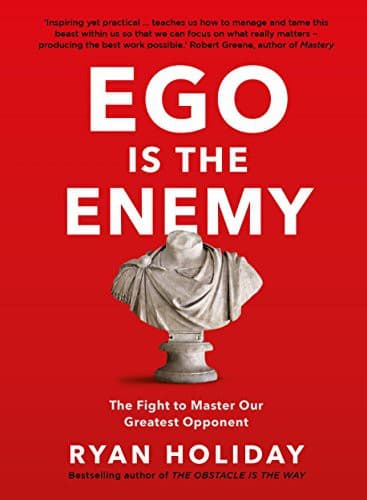
Ego is the Enemy
by Ryan Holiday
A short, Stoic-flavored case that the biggest obstacle to talent and success is often your own ego, with practical ways to stay teachable, focused on the work, and open to criticism.
What It's About
Ego Is the Enemy is a short self-help book by Ryan Holiday, who draws heavily on Stoic philosophy and on the careers of creative and business figures he has studied or worked with. Its central argument is that most people do not fail for lack of talent. They fail because their ego gets in the way of learning, working steadily, and accepting feedback.
The book is organized in parts that move from aspiring to doing the work to sustaining it over time. Each section targets a specific way ego sabotages people, such as wanting credit before earning it, resisting correction, or chasing status instead of craft. Holiday writes in brisk, direct prose with short sections, quotations from ancient and modern thinkers, and a steady push toward concrete habits.
Reading it feels less like studying a theory and more like being nudged by a coach who wants you to get out of your own way. It is quick to finish and easy to dip into. It is most useful when you are in the middle of a project and notice your own defensiveness or impatience, which is exactly when its advice is hardest to ignore.
Read this if you…
- are early in a creative or professional career and feel stuck despite real effort
- want a short, pointed push to stop taking criticism personally
- prefer direct, practical advice to long theoretical discussion
Skip it if you…
- want rigorous research or detailed evidence behind each claim
- find an anecdote-heavy, motivational self-help tone grating
Key Ideas
- 1
Staying a student no matter your success
Holiday argues that the people who keep improving are the ones who still see themselves as learners. Once you believe you have nothing left to learn, your growth stalls and your work slowly declines. The book frames the beginner's openness as an active competitive advantage rather than a stage you grow out of.
- 2
Focusing on the work instead of the reward
A recurring theme is that ego pulls attention toward praise, recognition, and status, which are outside your control. Holiday pushes readers to put their energy into the process they can actually influence. The idea borrows the Stoic habit of separating what you control from what you do not.
- 3
Why criticism feels like a threat
The book examines how defensiveness turns useful feedback into personal injury, so people ignore the very information that would help them improve. Holiday presents a more detached way of hearing critique, treating it as data about the work rather than a verdict on your worth.
- 4
Humility as a practical strategy
Rather than treating humility as a moral virtue, the book presents it as a working method. Admitting what you do not know, asking for help, and letting results speak can lead to better decisions and longer-lasting progress. The argument is pragmatic, aimed at people who care about results.
Limitations
Critics often point out that the examples are selective and drawn from a narrow circle of artists, entrepreneurs, and marketers, which can make the lessons feel one-sided. The core ideas will be familiar if you have read Stoic philosophy or Holiday's other books, since much of the material overlaps with them. The book also gives less guidance on how ego plays out in managing teams, leading organizations, or working in environments where status is formally tied to your role. Some readers will find the message more inspirational than operational.
Questions Readers Ask
- Is Ego Is the Enemy worth reading if I already know Stoicism?
- It can still be useful, but expect a lot of overlap. If you know Marcus Aurelius and Epictetus well, you will recognize most of the framing. The value is in its narrow focus on the internal barriers that stop people from doing good work, and in how directly it applies those ideas to ambition and creative work.
- Is the book still relevant today?
- The core message about ego, feedback, and focus is timeless, since those problems predate any particular era. Some of the examples and references reflect the media and business world of the mid-2010s, so a few details may feel dated. Most readers will find the underlying principles hold up well.
- Published
- 2016
- ISBN
- 9783959720328
- Difficulty
- beginner
- Category
- Self-Improvement
Book details and cover from Google Books.
Ready to read Ego is the Enemy?
Get your copy on Amazon, or listen to it on Audible. We earn a commission if you buy through these links.