
We earn a commission if you buy through these links. Learn more
Economics in One Lesson
Guide by the Books of the Day editors · Updated · How we write our guides
A short, sharp case that most bad economic policy comes from judging only what is seen, plus a lasting training in asking what happens next.
What Creators Say About Economics in One Lesson
2 creators reviewed Economics in One Lesson on YouTube between 2010 and 2023, with 60.6K views between them. Their opinions are their own; we picked these reviews, we didn't write them.
What It's About
Economics in One Lesson is a short, plainspoken argument that much bad economic policy comes from one habit: judging a proposal only by its visible, immediate effects while ignoring what follows later and what happens to people who are not in the room. Hazlitt, a longtime journalist rather than an academic, builds his case through concrete policy questions instead of equations. Each chapter takes a popular proposal and follows its consequences through the economy, asking who gains, who pays, and what never gets built or bought as a result.
The style is brisk and argumentative. Hazlitt returns often to his central test, which can feel repetitive, but that repetition makes the book easy to hold in your head. He writes for a general reader and assumes no training, so there are no graphs and very little jargon. Reading it feels less like studying a textbook and more like sitting across from a sharp columnist who keeps asking the question you forgot to ask.
The experience is quick and pointed. You can finish it in an evening or two, and it will probably change how you hear political debates, because it gives you a repeatable question to ask of almost any policy. It is less a survey of economic theory than a training exercise in skepticism toward appealing short-term fixes.
Read this if you…
- want a clear, short framework for spotting flaws in political and economic arguments
- are skeptical of government intervention and want the strongest version of that case
- are new to economics and want the basic logic before tackling heavier books
Skip it if you…
- want rigorous modeling, data, or up-to-date macroeconomic analysis
- want a balanced survey that gives market-failure and Keynesian arguments their full weight
Key Ideas
- 1
The seen and the unseen
Policies are usually judged by the jobs or goods they visibly produce, while the resources diverted, the work that never happens, and the spending that gets cancelled stay out of view. Hazlitt's whole method is to make these hidden costs visible so they can be weighed against the visible benefits.
- 2
Destruction is not a source of prosperity
Breaking things is sometimes praised as stimulus because it creates work for repairers. Hazlitt argues that the money spent on repair is money not spent on something else, so the community ends up poorer, not richer. Real wealth comes from producing things people want, not from replacing what was lost.
- 3
Price controls hide scarcity rather than removing it
When governments cap rents or prices below what the market would set, the underlying shortage does not disappear. It reappears as queues, black markets, and declining quality. Hazlitt contends that the people a cap is meant to help are often not the ones it actually benefits.
- 4
Government spending is never free
Public works and deficit spending are often presented as creating jobs from nothing. Hazlitt argues that money spent by government comes from taxes or borrowing that would otherwise have funded private activity. The useful question is what the economy gives up, not only what it gains.
- 5
Judging policy by its effects on everyone
The closing lesson asks you to consider every group affected, not only the ones a policy visibly favors, and to follow consequences over time. Hazlitt presents this as a habit of thought more than a set of conclusions, and it is the part of the book most worth carrying away.
Limitations
Economists across the spectrum criticize the book for making a one-sided case, sometimes against simplified versions of opposing arguments, especially Keynesian ideas about spending during recessions. It says little about externalities, public goods, monopoly, or distributional questions that mainstream economists treat seriously. Its examples come from the 1940s and early postwar debates, and many of the policy questions have shifted since. Reading it as a critique of one school of thought, rather than a complete account of the field, avoids the main trap.
Questions Readers Ask
- Is Economics in One Lesson still relevant today?
- The core test about hidden costs applies well to rent control, tariffs, and stimulus debates today, so the logic travels. The specific examples and policy fights are dated, and modern macroeconomics has moved well beyond the arguments of the 1940s. Read it for the method rather than as a guide to current economic facts.
- How does it compare to Bastiat's What Is Seen and What Is Not Seen?
- Hazlitt builds openly on the seen-versus-unseen idea associated with Frédéric Bastiat, a nineteenth-century French writer. Bastiat's essays are shorter and more playful, while Hazlitt's book is longer, more systematic, and covers more policy areas. Reading both shows the idea in two different registers.
- Who should read it instead of a standard textbook?
- It suits readers who want to understand arguments in the news without taking a course. Anyone who wants theory, evidence, and technical tools should read it as an opening argument and then move to a fuller principles text to fill the gaps.
- Published
- 1946
- ISBN
- 9780517548233
- Difficulty
- beginner
- Category
- Business
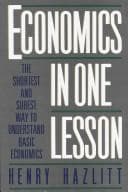
Book details and cover from Google Books.
Ready to read Economics in One Lesson?
Get your copy on Amazon, or listen to it on Audible. We earn a commission if you buy through these links.