
We earn a commission if you buy through these links. Learn more
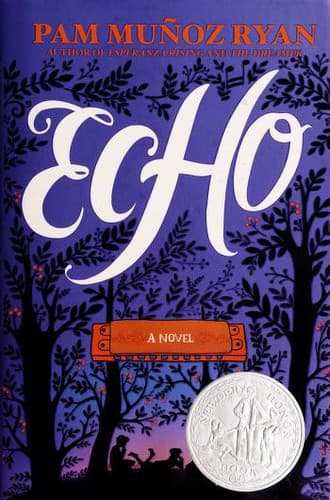
Echo
Guide by the Books of the Day editors · Updated · How we write our guides
A middle-grade novel that braids four children's lives across the Depression and wartime years into one story, held together by a battered harmonica and a touch of fairy-tale magic.
What Creators Say About Echo
2 creators reviewed Echo on YouTube between 2017 and 2020, with 12.4K views between them. Their opinions are their own; we picked these reviews, we didn't write them.
What It's About
Echo is a middle-grade novel for roughly ages nine to twelve, though adult readers who like historical fiction will find it quick and affecting. Its structure is the main thing to know going in. Instead of following one protagonist, it moves between four young narrators whose lives unfold in different places and circumstances in the years leading up to and during the Second World War. Their stories seem unrelated at first, and the reader is left to notice the threads that connect them.
The connective tissue is a harmonica and a mysterious figure who appears as a kind of guide, lending the book a fairy-tale quality without turning it into a fantasy. Music is the emotional language here. Each child's relationship to playing, listening, or being heard shapes the choices they make under pressure, and the book is more interested in how those choices feel than in the mechanics of history.
Reading Echo feels like watching a set of separate rooms gradually reveal a shared wall. The prose is clean and direct, the chapters are short, and the pacing rarely lets up. Expect a gentle, hopeful read that handles hardship honestly but leaves room for wonder, rather than a dense or immersive portrait of any single historical moment.
Read this if you…
- want a historical novel that spans several countries and lives without requiring a heavy reading commitment
- enjoy stories where music and small, portable objects carry emotional weight
- are looking for an accessible, hopeful book to read with a middle-grade child or to revisit as an adult
Skip it if you…
- want dense historical detail, political analysis, or a close look at how the war unfolded
- prefer fantasy with a fully worked-out magic system or a clear set of rules
Key Ideas
- 1
Four children, one thread of connection
The book's central design is its rotation between several young narrators whose lives seem separate. Part of the pleasure is noticing how their paths touch, and how a small object or act of kindness in one story ripples into another. The structure rewards close attention and makes the reader an active participant in putting the pieces together.
- 2
Music as a means of survival and identity
For these characters, playing and listening are more than hobbies. Music becomes a way to keep a sense of self, to communicate when words fail, and sometimes to earn a place in a community that is hostile to them. The book treats musical talent as something personal and fragile rather than as a rags-to-riches device.
- 3
Hardship seen through children's eyes
The historical settings, including poverty, prejudice, and war, arrive through the limited understanding of young narrators. This keeps the tone accessible for younger readers and lets adults notice what the children do not yet grasp. The book trusts readers to feel the weight of events without dwelling on graphic detail.
- 4
Light fantasy as a framing device
A mysterious, fairy-tale presence hovers over the narrative and suggests that kindness and chance can work in ways no one fully controls. The magic is restrained and never fully explained, which some readers will find moving and others will find convenient. It shapes the book's hopeful outlook more than its plot mechanics.
Limitations
Because the book spreads its attention across four narrators, several of them get less room to develop than a single-protagonist novel would allow, and some emotional turns can feel quicker than their weight deserves. The fairy-tale element is intentionally vague, which some readers will find lovely and others will find too convenient as a way to resolve tension. The treatment of the wartime and prejudice material is necessarily simplified for its audience, so adult readers looking for historical nuance may want to read more widely afterward. Its emotional sincerity is a strength, but it can also feel sentimental to readers who prefer a sharper edge.
Questions Readers Ask
- Is Echo suitable for adults or only for children?
- It is written for middle-grade readers, but many adults enjoy it, especially those who like historical fiction or want a short, warm read. Its language is simple and its chapters are brief, so it reads quickly. Adults looking for complex historical analysis or literary depth may find it lighter than they would like.
- Do I need to know much history before reading it?
- No. The book introduces its settings through the eyes of its child narrators and does not assume prior knowledge. Some background on the Depression and the Second World War will make the connections feel richer, but it is not required to follow the story.
- How does it compare with other historical novels for young readers?
- Echo is more interested in emotional connection and interwoven lives than in a single period drama. Readers who enjoyed its structure may appreciate other multi-narrator books for young audiences, while those wanting a straightforward war story will probably find it more diffuse.
- Published
- 2015
- ISBN
- 9781338133028
- Difficulty
- beginner
- Category
- History
Book details and cover from Google Books.
Ready to read Echo?
Get your copy on Amazon, or listen to it on Audible. We earn a commission if you buy through these links.