
We earn a commission if you buy through these links. Learn more
Earth abides
Guide by the Books of the Day editors · Updated · How we write our guides
George R. Stewart's 1949 novel follows Ish, a plague survivor, as he rebuilds life in a ruined America. Slow, patient, and humane; see who it suits.
What Creators Say About Earth abides
2 creators reviewed Earth abides on YouTube between 2015 and 2019, with 351.9K views between them. Their opinions are their own; we picked these reviews, we didn't write them.
What It's About
Earth Abides follows Isaac Williams, called Ish, a young man who survives a mysterious epidemic that wipes out most of the population and leaves the country largely empty. Stewart spends the early part of the book on the practical business of staying alive: finding food, working out what still functions, and deciding whether to stay put or travel. Rather than building toward one climactic crisis, the novel moves across decades, following Ish as he gathers other survivors and tries to make sense of a world without its old structures.
The style is calm, observational, and deliberately unhurried. Stewart writes with the patience of a historian, often stepping back to describe how plants, animals, and buildings respond when people stop maintaining them. Dialogue is spare and the narration can feel detached, which some readers will find restful and others will find cold. The book's scope is broad, and its real subject is less the disaster itself than the slow, uneven passing of knowledge and habit from one generation to the next.
Reading it feels less like following a thriller than sitting with a long, sober meditation on memory, continuity, and what people choose to keep. Its emotional force builds quietly, and many readers find the later sections linger well after the final page.
Read this if you…
- enjoy slow, reflective novels more than plot-driven ones
- are curious about how society might rebuild after a collapse
- like big-picture stories that span several decades
Skip it if you…
- want fast pacing, suspense, or a clear, escalating plot
- need a contemporary voice and up-to-date views on race and gender
Key Ideas
- 1
Civilization as something people must maintain
Stewart treats modern society as a set of ongoing efforts rather than a permanent fact. Once the people who run power plants, roads, and supply chains are gone, the systems decay at different speeds. The book shows how much of daily comfort depends on work most people never see, and how quickly that work stops being done once no one is left to do it.
- 2
Nature reclaiming what people leave behind
A large share of the novel's attention goes to the environment slowly absorbing human traces. Stewart pays close attention to weather, vegetation, and animal populations as they shift without human interference. Readers who enjoy natural history will find these passages some of the most absorbing, because they make the land itself feel like a character with its own long timeline.
- 3
Memory, inheritance, and what gets lost
As the survivors' children and grandchildren grow up, the book asks what the next generation actually inherits. Some knowledge survives as stories, some as habits, and much of it simply disappears. Stewart is interested in how memory thins over time and how people reconstruct meaning from fragments of an earlier world they never saw.
- 4
Whether progress is a straight line
The novel quietly questions the idea that human society moves steadily forward. Its long time span lets the reader watch communities form, change, and drift in directions no one planned. Stewart does not offer a tidy verdict on whether the new order is better or worse, which leaves the question open and gives the book much of its lasting interest.
Limitations
The book's age shows. Its depictions of race, gender, and social roles reflect assumptions common in 1949, and some passages will strike modern readers as dated or uncomfortable. The pace is deliberately slow, with long stretches of routine that some will find tedious. Characterization is often thin, and Ish can feel more like an observer than a fully felt presence. Its survival practicalities and some of its science are also outdated, so it is best read as a period piece as much as a timeless vision.
Questions Readers Ask
- Is Earth Abides still worth reading today?
- Yes, especially for its ideas about maintenance, ecology, and generational memory, which remain relevant. Its prose and attitudes are dated, though, so it works best if you read it as a product of its era. Readers who can accept that will find it one of the most thoughtful post-collapse novels ever written.
- How does it compare to The Road or Station Eleven?
- The Road is bleaker and far more intense, focused on a father and son in constant danger. Station Eleven is more interested in art and connection across time. Earth Abides is slower and more concerned with the long, uneven drift of society over decades, so it suits readers who want patience over plot.
- Do I need any background to enjoy it?
- No. The prose is plain and needs no scientific or literary background. What matters more is patience, since the book moves slowly and lingers on routine. If you enjoy quiet, observational fiction, you should find the pace rewarding rather than frustrating.
- Published
- 1949
- ISBN
- 9780552111942
- Difficulty
- intermediate
- Category
- Fiction
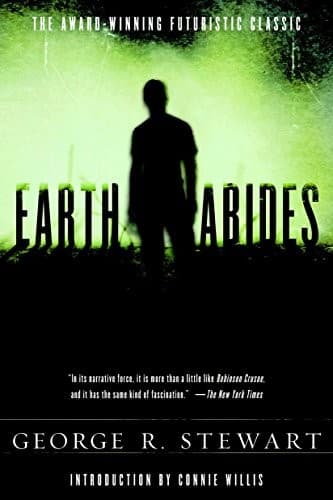
Book details and cover from Google Books.
Ready to read Earth abides?
Get your copy on Amazon, or listen to it on Audible. We earn a commission if you buy through these links.