
We earn a commission if you buy through these links. Learn more
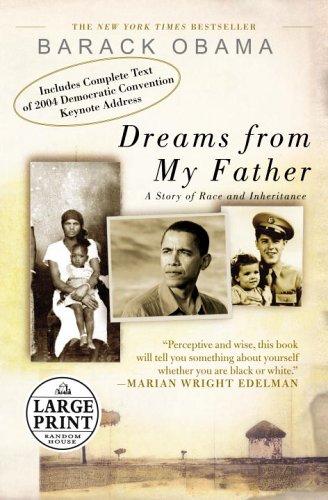
Dreams from My Father
by Barack Obama
A reflective coming-of-age memoir that uses one young man's search for his absent father to explore race, identity, and belonging, written before its author entered national politics.
What It's About
Dreams from My Father is Barack Obama's memoir of his youth and early adulthood, first published in 1995 and revised in 2004. It opens with his childhood in Hawaii and Indonesia, where he was raised largely by his mother and maternal grandparents after his Kenyan father had left the family when he was very young. Much of the book is an attempt to reconstruct a man he knew only briefly and mostly through other people's accounts.
The structure moves between childhood memories, his years as a student in California and New York, and his time working with churches and residents on the South Side of Chicago. The writing is literary and reflective rather than reportorial. Obama spends as much time weighing his own motives and doubts as narrating events, and he returns often to the question of where a person of mixed heritage belongs. Reading it feels closer to listening to someone think aloud than to following a standard life story.
Expect a slow, interior book. Some stretches, especially the sections on Chicago organizing, are dense with detail and argument, while the later Kenya material carries the emotional weight of the whole project. It rewards patience more than speed.
Read this if you…
- want a memoir about searching for family and self rather than a campaign story
- are interested in how mixed-race identity is shaped by place and upbringing
- enjoy reflective, literary nonfiction that rewards slow reading
Skip it if you…
- want a fast-paced account of political life or policy
- prefer memoirs with a clear narrative drive and few digressions
Key Ideas
- 1
Identity as something built, not inherited
Obama treats race and identity as choices shaped by family, neighborhood, and the people around him rather than fixed categories. He describes trying on different versions of himself as a teenager, moving between Black friends, white classmates, and the expectations placed on him. The book's interest lies less in declaring an answer than in showing how the search itself shapes a person.
- 2
A father known through absence and stories
He never really knew his father, who returned to Kenya, so the book is partly a reconstruction from relatives' accounts and his own imagination. The trip to Kenya to meet his paternal family is where the search turns from longing into confrontation with reality. Notice how much of the book concerns the gap between the story someone tells about a parent and the person who actually lived.
- 3
Community work as a test of belief
His years as an organizer in Chicago, working with churches and residents, are presented as an attempt to find a place to belong and a way to act on his principles. He is candid about the slow pace of progress and the frustrations of working inside institutions. Readers interested in civic life will find a grounded picture of organizing rather than a polished success story.
- 4
Memory with unreliable edges
The memoir is open about its method: it reconstructs conversations, blends some characters, and admits that memory is imperfect. The prose is careful and sometimes ornate, and the book reads as an act of self-examination. Pay attention to how the narrator questions his own interpretations of events.
Limitations
Many readers note that the book is more interior than its title suggests, and it is not a political autobiography. Obama's Senate career and presidency are absent because the book predates them. Some critics find the middle sections slow or overly introspective. Because the memoir relies on reconstructed dialogue and recollections gathered from memory and secondhand accounts, its scenes should be read as the author's version of events. It also offers limited perspective on the Kenyan relatives beyond how they appeared to him.
Questions Readers Ask
- Is Dreams from My Father worth reading if I'm not interested in politics?
- Yes, many readers come to it for the family story rather than the politics. The political material is limited because the book was written before Obama held national office. Its core is a son's effort to understand his absent father, his mother's choices, and his own sense of where he belongs. If you enjoy personal memoir about identity, it stands on its own.
- How does it compare to other memoirs about race and family?
- It is more literary and introspective than many memoirs of public figures. Where political memoirs often focus on public events, this one stays close to private doubt and family history. Readers who liked James McBride's The Color of Water or Ta-Nehisi Coates's Between the World and Me may find overlapping themes of race, family, and identity, though the tone and structure differ.
- Does the book still hold up?
- Its central questions about identity, absence, and belonging remain relevant, and the writing has aged well. Some context has changed, since the late-1980s setting and the Chicago community politics it describes belong to a particular era. Read it as a portrait of a young man figuring things out rather than as a guide to the present.
- Published
- 1995
- ISBN
- 9789571349268
- Difficulty
- intermediate
- Category
- Biographies
Book details and cover from Google Books.
Ready to read Dreams from My Father?
Get your copy on Amazon, or listen to it on Audible. We earn a commission if you buy through these links.