
We earn a commission if you buy through these links. Learn more
Dreadnought
A vivid, well-paced account of how Britain and Germany raced to build battleships before 1914, and how that rivalry helped push Europe toward war.
What It's About
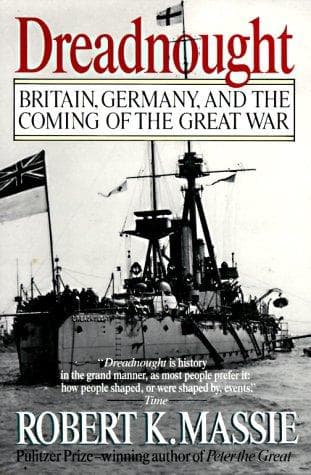
Dreadnought: Britain, Germany, and the Coming of the Great War is by Robert K. Massie, the American narrative historian known for his popular books on the Romanovs and Peter the Great. The listing's author name appears to be a mix-up. The title refers to the British battleship launched in 1906, which made every existing capital ship obsolete overnight and kicked off a costly contest between the Royal Navy and the Imperial German Navy. The book follows that rivalry from the late 1890s to the outbreak of war in 1914.
Massie builds the story around people. Admiral Jackie Fisher, Winston Churchill at the Admiralty, Kaiser Wilhelm II, and Admiral Tirpitz drive most of the action, and he moves between Whitehall, Berlin, and the fleets at sea. He pays close attention to budgets, parliamentary fights, and press campaigns, showing how naval policy was argued out in public as much as in the admiralties. The tone is confident and readable, closer to a long magazine feature than a dense academic monograph.
Reading it, you watch sensible-looking decisions pile up into something nobody quite wanted. The naval side is the strongest part, with the technology and politics explained in plain language. The land war and the diplomatic crises get less room, so the book works best as a focused study of one thread in the road to 1914.
Read this if you…
- want a clear account of how the pre-1914 naval race shaped the origins of the First World War
- enjoy narrative history built around vivid characters and backroom political maneuvering
- are new to naval or diplomatic history and want an accessible entry point
Skip it if you…
- need detailed coverage of trench warfare or the land campaigns of 1914 to 1918
- want a rigorous, source-by-source academic debate about the causes of the war, since Massie's storytelling and sympathies are plainly visible
Key Ideas
- 1
A design that made the fleet obsolete
Fisher's all-big-gun battleship rendered existing warships outdated almost at once. Britain's early lead was suddenly measured in new hulls and turrets, not just ship counts, and Germany had to rebuild its program to keep pace. The book shows how a single engineering decision reset the strategic balance and turned naval planning into an expensive race.
- 2
Naval building as domestic political weapon
Warship estimates became contested political issues in both countries. Newspapers, patriotic leagues, and parliamentarians pushed for bigger programs, while finance ministers resisted the cost. Massie shows how fear of the other side was cultivated at home, making it harder for governments to back down even when they wanted to.
- 3
Ambition and temperament shaping strategy
Fisher's restless reforms, Churchill's energy, Tirpitz's long-term plans, and the Kaiser's volatility all shaped outcomes. Massie treats personality as a real force in policy rather than background color, so the reader sees how individual choices and rivalries fed the arms race.
- 4
How naval rivalry fed the road to 1914
The book argues that the Anglo-German race hardened suspicion and made each side see the other's moves as threats. It presents the naval contest as a major contributor to the crisis of 1914 rather than the sole cause, and it lets the reader judge how far rising fear turned diplomacy toward war.
Limitations
Massie's account leans toward British perspectives and toward the vivid personalities at the top, which can make broader structural forces such as alliance systems, economic pressures, and military planning feel secondary. Some historians argue the arms race is given too much weight as a cause of the war. Because the book dates from 1991, it does not reflect later scholarship on German decision-making and the July Crisis, so it should be read as a strong account of one thread rather than the final word.
Questions Readers Ask
- Is Dreadnought still worth reading?
- Yes, especially for its narrative skill and its clear explanation of the naval race. Its technical and political story still holds up well. Historians have since expanded the work on July 1914 and German policy, so readers who want the latest arguments should pair it with newer studies.
- Do I need prior knowledge of naval history?
- No. Massie explains the ship types, budgets, and political terms as they come up, and the cast of characters is introduced with enough context to follow. Some readers may still want a map or a glossary of naval ranks and ship classes nearby.
- Published
- 1991
- ISBN
- 9785557098823
- Difficulty
- intermediate
- Category
- History
Book details and cover from Google Books.
Ready to read Dreadnought?
Get your copy on Amazon, or listen to it on Audible. We earn a commission if you buy through these links.