
We earn a commission if you buy through these links. Learn more
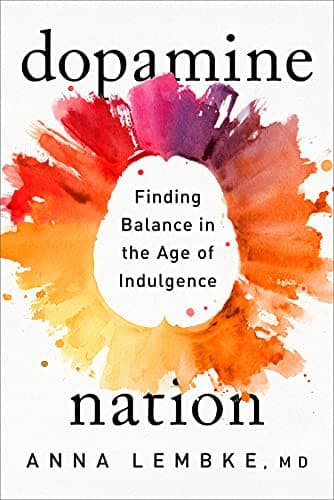
Dopamine Nation
by Anna Lembke
A psychiatrist's clear-eyed look at how endless easy rewards hijack motivation, paired with practical ways to reset your relationship with screens and cravings.
What It's About
Dopamine Nation is a psychiatrist's attempt to explain why modern life, with its phones, feeds, snacks, shopping apps, and on-demand everything, can leave people restless even when they have plenty. Anna Lembke, who directs an addiction clinic at Stanford, writes from years of treating patients whose struggles range from gambling and pornography to gaming and compulsive scrolling. Her core claim is that the brain's reward system works like a scale that tips toward pleasure and then pushes back with discomfort, and that repeated easy stimulation can leave us needing more just to feel ordinary.
The book moves between brain science and clinical stories. Lembke leans on case examples to show how compulsion looks from the inside, and she is careful to separate the everyday overuse most readers will recognize from full addiction. Her writing is conversational and direct, closer to a doctor talking you through a problem than a research summary, and she avoids heavy jargon while still explaining the mechanisms behind her advice.
Reading it feels less like being told what to do and more like being asked to take an honest inventory of your own habits. The practical sections are the payoff for many readers, offering concrete ways to reduce overstimulation and rebuild tolerance for ordinary pleasures. It is a reflective read that works well in pieces, and it tends to leave readers looking at their phones a little differently.
Read this if you…
- want a clinician's explanation of why phone and snack habits feel so hard to break
- are curious about the brain's reward system explained without heavy technical language
- prefer practical, personal steps over theory alone
Skip it if you…
- want a rigorous research review with detailed study-by-study citations
- need a treatment manual for recovering from a specific substance addiction
Key Ideas
- 1
Pleasure and pain sit on one balance
Lembke describes the brain as always seeking equilibrium. After a pleasurable experience, a counter-reaction of discomfort follows, and with repetition that counter-reaction grows while the original high shrinks. This explains why the restless letdown after a long stretch of scrolling or snacking can feel worse over time, even when the activity itself seems harmless.
- 2
Easy rewards are always within reach
The author argues that today's environment is unusual because pleasure is available constantly, cheaply, and without effort. Friction that once naturally limited indulgence, such as having to leave the house or wait for something, has largely disappeared. Her point is not that people are weak but that the surroundings are built to make restraint harder than it used to be.
- 3
Why deliberate abstinence can reset tolerance
Lembke proposes voluntary periods of stepping back from high-stimulation activities, which she calls a dopamine fast. She frames this as a way to recalibrate the reward system so that ordinary pleasures feel satisfying again, rather than as punishment or willpower for its own sake. Readers should note this advice rests mainly on clinical experience.
- 4
Compulsion extends beyond substances
Much of the book argues that gaming, gambling, shopping, pornography, and phone use can produce patterns similar to drug dependence. Lembke uses this to blur the line between a bad habit and a disorder, asking readers to notice when a behavior has stopped being a choice and started driving the choices around it.
Limitations
Critics note that the dopamine framing simplifies a complicated system, since neuroscientists tend to link dopamine more closely to motivation and prediction than to pleasure itself. Many readers find the clinical stories persuasive but hard to verify, and the fasting advice rests more on clinical experience than on controlled trials. The book is written largely from a US perspective and says less about social and economic drivers of compulsion, or about people for whom structured abstinence is hard to arrange.
Questions Readers Ask
- Is Dopamine Nation still relevant?
- Yes. Its central concern, how cheap and constant stimulation shapes attention and craving, has become more pressing since the book appeared in 2021, as short-form video and always-on apps have grown. The practical advice remains a useful starting point, though newer research on digital habits has added detail the book does not cover.
- How does it differ from Nir Eyal's Indistractable?
- Eyal's book is a productivity manual focused on managing attention and tech habits through tactics. Lembke's is closer to a clinical explanation of why those habits take hold, drawing on addiction medicine. Readers who want a step-by-step plan may prefer Eyal, while those who want to understand the underlying compulsion will likely find Lembke more illuminating.
- Published
- 2021
- ISBN
- 9786586551716
- Difficulty
- beginner
- Category
- Tech
Book details and cover from Google Books.
Ready to read Dopamine Nation?
Get your copy on Amazon, or listen to it on Audible. We earn a commission if you buy through these links.