
We earn a commission if you buy through these links. Learn more
Doomsday book
Guide by the Books of the Day editors · Updated · How we write our guides
Connie Willis treats time travel as a human problem rather than a gadget puzzle, asking what a historian owes the people she studies and what happens when the past and present both go wrong.
What Creators Say About Doomsday book
2 creators reviewed Doomsday book on YouTube between 2023 and 2024, with 2.2K views between them. Their opinions are their own; we picked these reviews, we didn't write them.
What It's About
Doomsday Book follows Kivrin, an Oxford history student in the mid-twenty-first century, who is sent back to rural England in 1320 to study daily life in a medieval village. The trip is supposed to be carefully planned and safe. The novel alternates between her village and the Oxford of her own time, where the people responsible for sending her are dealing with a sudden illness spreading through the town.
Willis writes patiently and immersively. Much of the pleasure lies in texture: the cold, the dirt, the language barrier, the strange logic of medieval manners, and the faith of people who have little reason to trust a stranger. The Oxford sections are funnier, full of bumbling administrators and overlapping crises, and the comedy and dread sit side by side for most of the book.
Reading it is more of an emotional experience than a puzzle. The time-travel mechanics are present but never the point. Expect a long book that asks for patience, especially early on, and a payoff that depends on caring about both timelines.
Read this if you…
- want time travel treated as a human story rather than a technical puzzle
- enjoy immersive historical fiction with a dense, lived-in medieval setting and don't mind a slow build
- like books that can make you laugh and grieve within the same chapter
Skip it if you…
- want a fast plot with a clear mystery and a tidy explanation of how the time machine works
- find long stretches of village life or bureaucratic comedy more tiring than rewarding
Key Ideas
- 1
Historical empathy as the real subject
Kivrin's central challenge is not getting around the technology but understanding people on their own terms. Willis argues that really knowing the past means accepting its strangeness rather than judging it from the comfort of the present.
- 2
Two epidemics set side by side
The book pairs a medieval catastrophe with a modern one and asks what a society owes those it cannot protect. It also examines how much people actually learn from earlier disasters, and how quickly that learning fades.
- 3
Institutions as the real obstacle
The Oxford of the future is ordinary in its frustrations. Committees, budgets, and the search for someone to blame shape the response to the crisis as much as any scientific limit does, which makes the setting feel uncomfortably familiar.
- 4
Comedy and grief in the same scene
Willis moves between farce and tragedy without warning, and the shifts are deliberate. The humor does not lighten the dread so much as make the dread harder to bear, since the reader comes to care about the characters who are laughing.
- 5
The ethics of observing the past
Can a historian visit another era without changing it or harming the people in it? The novel keeps returning to this question, treating observation as a moral act with consequences rather than a neutral act of study.
Limitations
The book is long, and its opening can feel slow as Willis sets up two timelines and a large cast. Some readers find the Oxford farce repetitive or overextended, and the medieval characters, though carefully researched, are sometimes given modern sensibilities. The science of time travel is hand-waved, which is fine for most readers but frustrating for those who want rigor. The emotional weight depends on sustained attention, so readers who are impatient with the pacing may not reach the payoff.
Questions Readers Ask
- Is Doomsday Book really fantasy?
- It is usually classed as science fiction. Time travel is the engine of the plot, handled with a historian's attention to detail rather than a physicist's. The category listed here says fantasy, but readers who expect fantasy conventions may find it closer to historical science fiction.
- Do I need to know medieval history to enjoy it?
- No. Willis gives you enough context through Kivrin's own confusion and discoveries that you learn alongside her. Some background on fourteenth-century England will add depth, but the novel is built to be followed without prior study.
- How does it compare to Kindred?
- Both use time travel to examine how people in the past lived under real constraints. Kindred is tighter and more directly confrontational about slavery, while Doomsday Book is looser, funnier, and focused on the ethics of a historian who wants to understand her subjects sincerely.
- Published
- 1992
- ISBN
- 9780739487136
- Difficulty
- intermediate
- Category
- Fantasy
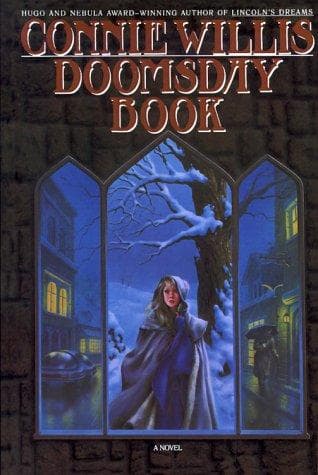
Book details and cover from Google Books.
Ready to read Doomsday book?
Get your copy on Amazon, or listen to it on Audible. We earn a commission if you buy through these links.