
We earn a commission if you buy through these links. Learn more
Dollars and Sense
Guide by the Books of the Day editors · Updated · How we write our guides
A readable tour of the mental shortcuts that make everyday money decisions go wrong, with practical habits for spending with more intention and less regret.
What Creators Say About Dollars and Sense
2 creators reviewed Dollars and Sense on YouTube between 2019 and 2023, with 990 views between them. Their opinions are their own; we picked these reviews, we didn't write them.
What It's About
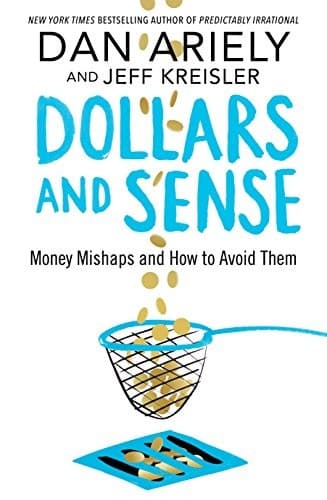
Dollars and Sense, written by behavioral economist Dan Ariely with science writer Jeff Kreisler, takes the idea that people are not perfectly rational and applies it directly to personal money. Rather than starting from abstract theory, the book keeps returning to the everyday situations where money gets muddled: how a price is presented, which account a payment seems to come from, and why a purchase that feels cheap in one context feels expensive in another.
The approach is anecdotal and conversational. Ariely's own experiments and the kinds of studies that behavioral economists run provide the backbone, and the authors translate them into scenarios most readers will recognize from their own wallets. The tone is friendly and fast-moving, with short sections that are easy to dip into. It rarely asks you to work through formulas, so the reading experience feels closer to a long conversation with a sharp, curious guide than to a textbook.
The result is less a complete financial plan than a set of lenses. Readers who finish it tend to walk away with a better sense of why they spend the way they do, and with a few tactics for slowing down the decisions that matter. It works best as a first step into behavioral finance rather than as a final word on budgeting or investing.
Read this if you…
- are new to behavioral economics and want an accessible entry point
- want to understand why you spend differently with cards, cash, or deals
- prefer stories and experiments over spreadsheets and formulas
Skip it if you…
- want a detailed guide to budgeting, retirement, or investing mechanics
- are looking for rigorous academic detail or a deep dive into the research behind each claim
Key Ideas
- 1
Money is not interchangeable
The book's central argument is that we treat dollars differently depending on their label, source, or intended purpose. A windfall, a paycheck, and money set aside for a goal can carry different psychological weight even when the amount is identical. Seeing this makes it easier to notice when your own choices are being shaped by labels rather than by what you actually value.
- 2
Framing changes what feels expensive
How a price is presented often matters more than the price itself. Comparisons, anchors, and the order in which options appear can make the same purchase feel like a bargain or a rip-off. The authors show how small changes in presentation can tilt choices, which is useful both for spotting manipulative marketing and for setting up your own decisions more deliberately.
- 3
Why paying feels less painful over time
Payment methods and delays change how much a purchase hurts. Cards, subscriptions, and deferred billing separate the act of buying from the feeling of losing money, which can lead to overspending that would seem unthinkable in cash. The book encourages readers to notice this gap and to build small friction back into the process where it counts.
- 4
Practical habits for spending with intention
Beyond diagnosis, the book offers concrete suggestions: pausing before purchases, setting up rules that remove some decisions from in-the-moment judgment, and reframing spending in terms of what you want it to do for you. These ideas are modest and mostly self-contained, so they can be tried without overhauling your whole financial life.
Limitations
Some readers find the book light on rigorous detail, and the anecdotal style means certain examples are illustrative rather than systematically tested. Its advice is more about awareness than about specific financial products, so it leaves gaps for people who need concrete planning tools. Because behavioral findings in this area have been debated and refined since publication, it is wise to treat individual claims as starting points for your own thinking rather than settled fact.
Questions Readers Ask
- Who is Dollars and Sense best suited for?
- It suits general adult readers who want to understand the psychology behind everyday money choices without wading through technical material. It is especially useful for people who suspect their spending is driven by impulse, framing, or payment habits and want a clear, friendly explanation of why that happens.
- How does it compare to a traditional personal finance book?
- Traditional personal finance books tend to focus on budgets, savings rates, and investment strategy. This book looks at the thinking behind those decisions. It is a complement rather than a replacement, and readers often find it more useful after they already have a basic financial plan in place.
- Published
- 2017
- ISBN
- 9780062872722
- Difficulty
- beginner
- Category
- Finance
Book details and cover from Google Books.
Ready to read Dollars and Sense?
Get your copy on Amazon, or listen to it on Audible. We earn a commission if you buy through these links.