
We earn a commission if you buy through these links. Learn more
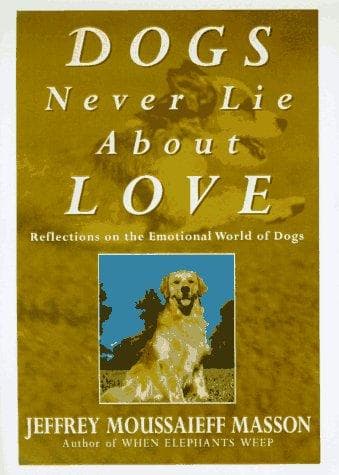
Dogs never lie about love
A warm, opinionated case that dogs feel love, grief, and jealousy much as we do, worth reading for anyone who has ever doubted their dog's inner life.
What It's About
Dogs Never Lie About Love is a short, personal book by Jeffrey Moussaieff Masson, a former Sanskrit scholar and psychoanalyst, who argues that dogs have a rich emotional life and that science and everyday culture have underestimated it. His central claim is that dogs experience feelings in ways that closely resemble ours, and that we dismiss this because we have been trained to treat animal emotion as sentimental or unprovable.
The book is less a systematic study than an extended essay built from observations, anecdotes, and the author's reflections on the people and dogs in his life. Masson moves between broad arguments about how humans think about animal minds and intimate descriptions of what dogs seem to feel when they greet, mourn, or wait for someone. Expect a conversational voice, an openly advocative stance, and few footnotes compared with a research monograph.
Reading it feels like sitting with a thoughtful dog lover who has clearly spent a lot of time watching animals and is impatient with dismissive explanations. It is an easy book to finish in a sitting or two, and it rewards readers who want to think more carefully about the relationship between dogs and people rather than simply being reassured about it.
Read this if you…
- want a warm, readable case for taking dogs' emotional lives seriously
- are curious about how philosophy and psychology have thought about animal feelings
- enjoy personal essays that mix close observation with broader arguments about how we treat animals
Skip it if you…
- want a rigorous, citation-heavy review of canine cognition research
- prefer a practical guide to training or understanding dog behavior day to day
Key Ideas
- 1
Emotion is not a uniquely human possession
Masson's core argument is that the basic emotions we see in people, such as affection, fear, sadness, and jealousy, are also present in dogs. He asks readers to take seriously what a dog's behavior seems to express rather than automatically reading it as conditioning or instinct alone.
- 2
Why scientific caution can become denial
He contends that a reasonable reluctance to attribute feelings to animals can harden into a habit of dismissal. The book pushes against the idea that anything we cannot measure directly must be treated as absent, and asks what that habit costs us in understanding and in how we treat animals.
- 3
The bond as a two-way emotional relationship
Much of the book focuses on attachment: how dogs seem to track and respond to the people they love, and how those responses shape the dog's own emotional state. Masson treats the relationship as something both parties experience, not a one-sided projection of human sentiment.
- 4
Anecdote as evidence, and its limits
A large part of the book's persuasive power comes from specific stories and observations. Readers who value controlled research will notice this reliance and should weigh the examples as illustrations of his argument rather than as proof of it.
Limitations
The book's main weakness is its method. It leans heavily on anecdote and personal observation, which makes it persuasive but harder to test, and critics have argued that it can project human emotional categories onto animals without adequately considering alternative explanations. Readers looking for the state of current animal cognition research will find it dated and selective. Its advocacy can also feel one-sided, since it spends more energy arguing against skeptics than mapping where the evidence is strong and where it is still thin.
Questions Readers Ask
- Is Dogs Never Lie About Love a scientific book?
- Not in the strict sense. It is a personal, argumentative essay that draws on observation, anecdote, and reflection rather than controlled experiments. It is best read as a thoughtful argument for taking dogs' emotions seriously, with the evidence presented as illustration rather than proof.
- Who will get the most from this book?
- Dog owners who already suspect their pets have real emotional lives, and general readers interested in animal minds, will likely enjoy it most. Readers who need methodological rigor or practical training advice should look elsewhere, as the book is more reflective than instructive.
- Published
- 1997
- ISBN
- 9780224044653
- Difficulty
- beginner
- Category
- Psychology
Book details and cover from Google Books.
Ready to read Dogs never lie about love?
Get your copy on Amazon, or listen to it on Audible. We earn a commission if you buy through these links.