
We earn a commission if you buy through these links. Learn more
Displacement
by Kiku Hughes
A graphic novel that uses a time-travel premise to make the World War II incarceration of Japanese Americans feel personal, through one family's memory and silence.
What It's About
Displacement is a graphic novel for teen and adult readers about a Japanese American girl whose family history becomes something she has to live inside. Kiku is a teenager in the present day, and the story moves between her ordinary life and her family's past, especially the wartime incarceration of Japanese Americans. Hughes builds the book around the way history survives in family stories: some things get repeated, some get left out, and some only make sense once you see them from the inside.
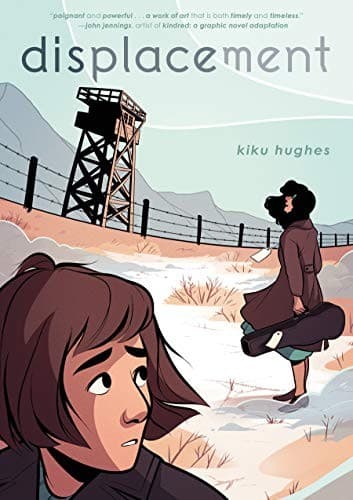
The art is simple and expressive, with clean lines and close attention to small domestic moments. That keeps the emotional weight grounded in everyday life rather than in speeches. The shifts between timelines are handled so the reader feels some of the disorientation Kiku feels, and the time-travel device works mainly as a way to put a present-day kid face to face with events that textbooks usually summarize in a paragraph.
Reading it is quick but not light. It is best as an emotional entry point into a piece of American history many readers know only in outline, and it asks what a family owes its past and what it chooses not to say. Expect a book driven by conversation, guilt, and understanding rather than by action or plot twists.
Read this if you…
- want an accessible graphic novel about the wartime incarceration of Japanese Americans
- are interested in how families pass down difficult history
- like quiet, character-driven stories with a speculative element
Skip it if you…
- want a sweeping, detailed historical account of the incarceration camps
- need a fast-moving plot with major twists or action
Key Ideas
- 1
History survives through family conversation
The book treats family memory as both a source of knowledge and a place where things go unsaid. Kiku learns the past partly from what her relatives tell her and partly from what they avoid, which makes the act of listening a central concern.
- 2
Time travel as a way to feel the past
The fantastical premise is less about puzzle-solving than about proximity. Kiku's trips into the past make abstract history concrete, and the story asks what it means to witness injustice rather than simply learn about it.
- 3
Incarceration seen through a young person's eyes
Much of the emotional force comes from watching a teenager confront conditions and choices that adults around her shaped. The perspective keeps the experience accessible without flattening its seriousness.
- 4
Identity across generations
Kiku's sense of who she is depends on people who came before her and on what they endured. The book explores how inherited trauma, pride, and silence shape a young person's understanding of heritage.
Limitations
The book is short, so it touches on its historical subject more than it explores it in depth. Its story is told mostly through one family's perspective, which gives intimacy but limits the wider picture. Some readers may find the time-travel mechanism convenient or underexplained, and others may feel the emotional beats rely on familiar patterns of family revelation. It works best as an introduction that can send readers to other sources for fuller history.
Questions Readers Ask
- Who is Displacement best for?
- It suits teen and adult readers who want an emotionally direct entry point into the Japanese American incarceration during World War II. It is a good choice for readers who prefer graphic novels and character-focused stories. Readers looking for dense historical analysis should pair it with nonfiction on the subject.
- Is Displacement still relevant today?
- Its central themes, about how governments and communities treat minority groups in wartime and how families remember that history, remain relevant. Readers may find its questions about memory and silence especially resonant in current debates over how history is taught.
- Published
- 2019
- ISBN
- 9781663631091
- Difficulty
- beginner
- Category
- Fiction
Book details and cover from Google Books.
Ready to read Displacement?
Get your copy on Amazon, or listen to it on Audible. We earn a commission if you buy through these links.