
We earn a commission if you buy through these links. Learn more
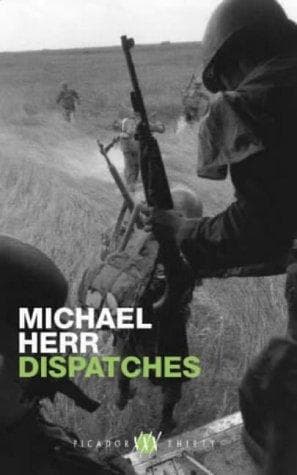
Dispatches
by Michael Herr
Michael Herr's Vietnam reportage captures the war's chaos, fear, and strange beauty through fragmented, poetic prose that still feels unlike anything else written about the conflict.
What It's About
Dispatches is Michael Herr's account of the Vietnam War as he saw it while reporting for Esquire in the late 1960s. It is not a conventional war history. There is little strategy room or policy debate here. Instead Herr moves between Saigon, firebases, and the ragged edges of combat, trying to render what the war felt like to the men inside it and to the journalists who followed them.
The approach is New Journalism pushed hard. Herr writes in short, cut-up sections that jump between scenes, voices, and half-remembered fragments, and he lets his own nerves, fear, and fascination show. The prose is dense with slang, rhythm, and vivid images, and it often reads more like poetry or jazz than straight reportage. Passages can hit with great force, then drift toward something close to hallucination, which mirrors the disorientation he describes.
Reading it is an immersive and sometimes exhausting experience. It is not a book to rush through. Most readers absorb it in pieces, returning to lines that stick, and many finish feeling they have been somewhere rather than simply learning facts about it. Its reputation also rests partly on its later influence: Herr went on to co-write the narration for Apocalypse Now and the screenplay for Full Metal Jacket, and that film connection is one reason many people pick it up.
Read this if you…
- want a vivid, immersive picture of the Vietnam War from the perspective of people who lived it
- enjoy experimental, poetic nonfiction and New Journalism
- are interested in how war journalism shaped later films and writing
Skip it if you…
- want a clear chronological history or an analysis of the war's politics and strategy
- prefer straightforward prose and find fragmented, dense writing tiring
Key Ideas
- 1
War as lived experience, not strategy
Herr is less interested in why the war was fought than in what it did to people on the ground. He focuses on sensation, boredom, terror, and the odd intimacy of combat, so the book works more as a record of mood and texture than as an argument about policy or outcomes.
- 2
Fragmented form as a way of seeing
The book's shattered structure is deliberate. Short, looping sections mirror a world where meaning arrives in flashes and context is always missing. Readers who expect a steady narrative will need to adjust, but the form makes the disorientation felt rather than merely described.
- 3
The reporter inside the story
Herr does not pretend to be a detached observer. He admits his own fear, appetites, and fascination, and he treats his presence as part of what he is reporting. This candor is central to the book's honesty, and it is also where some readers find it self-conscious.
- 4
Language as a way to cope
Soldiers, correspondents, and Herr himself build a private vocabulary of slang, gallows humor, and clichés to absorb what they witness. Paying attention to how the characters talk reveals as much about the war's psychological toll as the events they describe.
- 5
Fear, boredom, and the unreal
Combat in the book is rarely a steady stream of action. It alternates long stretches of waiting with sudden violence, and the gap between the two is what gives the book its unsettling tone. The sense that the war is both mundane and surreal runs through nearly every section.
Limitations
Despite its place in the Biographies category, this is not a life story. Its impressionistic method leaves gaps in the narrative, and readers looking for a clear sequence of events or explanation of the war's causes will find them missing. Critics have also noted that the drug-soaked, self-mythologizing style can feel indulgent at times, and the perspective is largely that of American male reporters and soldiers, with Vietnamese voices present mostly at the edges. The attitudes and language of the late 1960s are also part of the record, which some readers find dated.
Questions Readers Ask
- Is Dispatches a biography?
- Not really. Although it sits in the biographies category on many shelves, Dispatches is reportage and memoir about Michael Herr's time covering the Vietnam War. It follows moments, places, and people rather than tracing a life from beginning to end, so readers expecting a conventional biography may be surprised.
- Do I need to know about the Vietnam War before reading it?
- Some background helps, since the book assumes familiarity with places and events and rarely stops to explain them. But you do not need a detailed knowledge of the war. Many readers come to it with only a general sense of the conflict and still find its atmosphere powerful.
- How does it compare to other Vietnam War books?
- It is less systematic than histories and less conventional than most war memoirs. Where other books often focus on campaigns or individual soldiers' stories, Herr concentrates on mood, language, and the feeling of being there. Readers who want context should pair it with a history; those who want immersion will find few books that come as close.
- Published
- 1977
- ISBN
- 9782253027300
- Difficulty
- intermediate
- Category
- Biographies
Book details and cover from Google Books.
Ready to read Dispatches?
Get your copy on Amazon, or listen to it on Audible. We earn a commission if you buy through these links.