
We earn a commission if you buy through these links. Learn more
Diaspora
by Greg Egan
A demanding, idea-rich science fiction novel that asks what personhood means once minds can be copied and run as software, with mathematics and physics woven into the story.
What It's About
Diaspora is a 1997 science fiction novel by Greg Egan, set in a far future where many people have left physical bodies behind and live as software inside computer-run communities. Some of these minds are copies, some are spread across hardware far from Earth, and the book follows characters who must weigh what they owe to the physical world they came from and to one another. The questions are practical as well as philosophical, and the plot moves forward through them rather than through conventional action.
Egan writes with restraint and rigor. He rarely stops to lecture about his future, and he expects readers to assemble its rules from context, the way they would in a foreign city. The pace is uneven: long stretches of argument and discovery alternate with sharper scenes of tension. Expect dense passages on computation, cosmology, and mathematics. These are not decoration. They drive the story and the characters' decisions.
The experience is closer to working through a puzzle than to settling into a thriller. The reward comes from following the logic and seeing familiar questions about identity, death, and community made strange and specific. Readers who want warmth, lush description, or deep interior access to the characters may find the people more like instruments for the ideas than fully rounded figures.
Read this if you…
- enjoy hard science fiction that trusts you to work out its world
- want to see questions about identity and mind-uploading explored in depth
- don't mind long passages of mathematics and physics driving the plot
Skip it if you…
- want a fast-paced plot with steady action and cliffhangers
- prefer emotionally intimate characters with rich inner lives
Key Ideas
- 1
Personhood without a body
Egan takes seriously the idea that a mind might exist as software, copyable and movable. The novel explores what identity means when a person can exist in more than one place at once, and whether a copy is the same person in any sense that matters to the people involved.
- 2
Communities built from information
Rather than cities of stone, the book imagines societies made of data and computation. The social arrangements, economies, and disputes of these software communities feel strange but follow recognizable human patterns, which gives the setting its grounding.
- 3
Mathematics as the engine of the plot
Physics and mathematics are not background dressing here. Characters investigate the nature of the universe, and the answers shape what they can do and believe. Readers who enjoy seeing abstract ideas drive events will find this the book's most distinctive feature.
- 4
Obligation across distance and difference
A recurring concern is what the transcended owe to those who remain physical, and what different kinds of minds owe each other when their interests diverge. The book treats these obligations as genuinely hard rather than settling them with easy moral lessons.
Limitations
Egan's characters are often more vehicles for ideas than fully realized people, and readers who expect emotional payoff may feel the book holds them at arm's length. The technical material can be heavy going, and some readers find the early chapters disorienting because the world is introduced without much scaffolding. The book's concerns are abstract and cerebral, so it may feel less engaged with social or political texture than some other science fiction. Its speculation about computing and physics also reflects ideas of the late 1990s, which can make parts of it feel dated to modern readers.
Questions Readers Ask
- Do I need a background in physics or mathematics to enjoy Diaspora?
- Not strictly, but it helps. Egan usually lets the story carry you through the technical material, and some passages are more about the characters' reasoning than formal detail. Readers without a science background can still follow the book, though they may find some sections slow and need to read more attentively.
- How does Diaspora compare to other mind-uploading novels?
- Diaspora is more concerned with the physics and mathematics of its future than many books on similar themes. Readers who want a character-driven story about digital minds may find it colder. Those who want to see the consequences of uploading worked out rigorously will likely find it more satisfying than lighter treatments of the idea.
- Published
- 1997
- ISBN
- 9780752809250
- Difficulty
- advanced
- Category
- Fiction
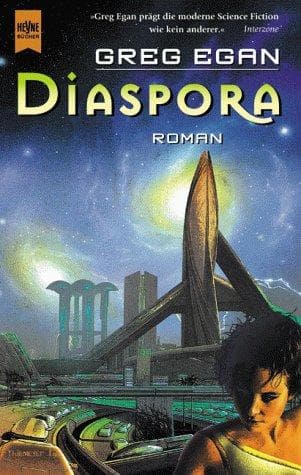
Book details and cover from Google Books.
Ready to read Diaspora?
Get your copy on Amazon, or listen to it on Audible. We earn a commission if you buy through these links.