
We earn a commission if you buy through these links. Learn more
Dhalgren
Delany's sprawling 1975 science fiction follows an amnesiac drifter through a half-abandoned city, rewarding patient readers with a puzzle that never fully resolves.
What It's About
Dhalgren, published in 1975, is a science fiction novel set in Bellona, an unnamed American city that seems cut off from the rest of the world. Its nameless protagonist, who calls himself Kid, arrives with no memory of his past, a gift for words, and a talent for getting by. Bellona has no real authority: fires burn in the streets, gangs roam, and the population has thinned to a restless few who drift between squats, parties, and violence.
Delany writes in a dense, looping style. Scenes often start in the middle, characters reappear under new names, and chronology bends back on itself, so the book asks you to assemble meaning as you go rather than follow a plot. The sentences are rich and sometimes deliberately opaque, and the sexual content is frank and frequent, which is part of how the book treats desire, community, and identity as things formed outside conventional institutions.
Reading it is less like following a story than living inside a mood. Long stretches can feel slow or disorienting, and the book rewards rereading more than a single pass. Its pleasures lie in its images, its sense of place, and the sustained feeling that everything could mean something. Expect to put it down often and come back to it.
Read this if you…
- enjoy experimental, demanding fiction and don't need a clear plot
- are interested in science fiction about city life, identity, and desire rather than spaceships
- want a book to live inside and reread, and can tolerate disorientation
Skip it if you…
- want a linear plot or a mystery with a satisfying solution
- find explicit sexual content or graphic violence hard going, or want a quick read
Key Ideas
- 1
Identity without a past
The Kid has lost his memory and keeps reinventing himself, taking new names and roles as circumstances change. Delany treats selfhood as something performed, repeated, and remade, and asks what remains of a person when the usual scaffolding of history and family is gone.
- 2
A city beyond ordinary order
Bellona is a social experiment in which the normal rules have collapsed. The novel looks at what communities form without authority, including gangs, lovers, and loose households, and how power, race, and gender still shape who gets protected and who gets hurt.
- 3
Form that mirrors meaning
The fragmented, circular structure is not decoration. Time breaks apart and reassembles, so the reader has to reconstruct the story much as the protagonist reconstructs himself. The book makes the act of making sense the subject as well as the method.
- 4
Queer life at the center
Desire between men, and between people who live on the margins, is shown frankly and without apology. Delany, a gay Black writer, puts these relationships at the heart of the book rather than at its edges, which was notable for science fiction at the time.
- 5
Ambiguity as a deliberate choice
Much of what happened to the city is left unexplained, and the book resists tidy answers. Readers who need closure may find this frustrating, but the uncertainty is central to the experience and to the novel's unsettled mood.
Limitations
Many readers find the book overlong and repetitive, and its mannered prose can feel more like a barrier than a pleasure in long stretches. The sexual content and violence are explicit and frequent, which some find excessive. Because it was written in 1975, its handling of gender and race reflects that era in ways that can feel dated. It also offers little resolution, which will disappoint readers who want the story to add up.
Questions Readers Ask
- Is Dhalgren a good first Samuel R. Delany book?
- Probably not for most readers. Delany's shorter and more accessible novels, such as Babel-17 or Nova, give a gentler introduction to his style and ideas. Many readers who love those books then come to Dhalgren as a deliberate challenge rather than a starting point.
- How does Dhalgren compare to Ursula K. Le Guin's The Left Hand of Darkness?
- Le Guin's novel has a more conventional structure and approaches gender through carefully built worldbuilding and a clear travel narrative. Dhalgren is more fragmented and interior, with a looser sense of plot. If you liked Le Guin's ideas but want something stranger and less tidy, Dhalgren is a natural next step.
- Is Dhalgren still worth reading today?
- Yes, for readers who want challenging science fiction. It is widely cited as a landmark of New Wave science fiction and of queer representation in the genre. Its experimental form and its questions about identity and community still feel fresh, even if some of its attitudes reflect the 1970s.
- Published
- 1975
- ISBN
- 9780586214190
- Difficulty
- advanced
- Category
- Fiction
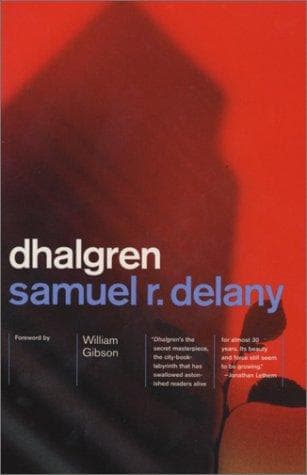
Book details and cover from Google Books.
Ready to read Dhalgren?
Get your copy on Amazon, or listen to it on Audible. We earn a commission if you buy through these links.