
We earn a commission if you buy through these links. Learn more
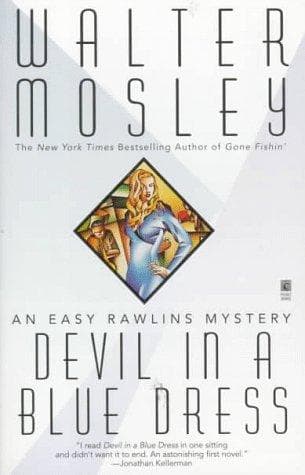
DEVIL IN A BLUE DRESS (Easy Rawlins Mysteries)
Walter Mosley's 1990 debut gives hard-boiled noir a Black protagonist, a sharp voice, and a 1948 Los Angeles where every favor and every threat carries racial weight.
What It's About
Devil in a Blue Dress is the 1990 novel that launched Walter Mosley's Easy Rawlins series, set in Los Angeles in 1948. Easy is a Black World War II veteran who has just lost his defense-plant job and is struggling to keep the mortgage on a house in a neighborhood where Black families were never meant to own property. A well-dressed stranger offers him a quick fee to find a woman who frequents the jazz clubs along Central Avenue. The job looks simple, and it isn't.
Mosley writes in the first person, and Easy's voice carries the book. His narration is wry, watchful, and weary of being underestimated, and he explains the rules of a white-controlled city the way someone who learned them the hard way would. The plot follows the familiar hard-boiled shape of a missing person, bodies, and a city full of people hiding things, but the pace is slower and more reflective than Chandler's, and the dialogue is loose, idiomatic, and full of period texture.
Reading it feels like walking through a specific place at a specific time: the nightclubs, the cheap rooms, the rumors that travel faster than the police. The mystery matters, but much of the pleasure lies in the texture and in watching Easy weigh every choice against the danger of being Black in a city that treats him as disposable. Expect violence and frank period language.
Read this if you…
- love hard-boiled detective fiction but want a protagonist whose world is shaped by race and class
- want a historical mystery that captures the texture of 1940s Los Angeles
- prefer character-driven narration with a strong, wry voice over fast-moving plot twists
Skip it if you…
- need a tightly plotted mystery where every clue clicks into place by the final chapter
- are uncomfortable with graphic violence, period slurs, or frank depictions of racism
Key Ideas
- 1
Race as the engine of the plot
The mystery is not just a puzzle to solve. Easy's choices are constrained by what white police, employers, and property owners can do to him, and every witness is weighing the same risks. Mosley makes the social order feel like a set of hidden rules that drive the action as much as any criminal does.
- 2
A detective who is never a free agent
Easy is a private investigator in name, but he has no real protection, no institutional backing, and little margin for error. His reluctance to take the case, and his caution once he does, come from knowing how quickly a Black man can be blamed for something he did not do. That tension gives the investigation its steady pressure.
- 3
Postwar Los Angeles as a character
The novel is rich with the sounds, neighborhoods, and economic anxieties of 1948, from the jazz scene on Central Avenue to the returning veterans facing shrinking work. The setting is not backdrop. It shapes who talks, who trusts whom, and what a missing person can mean to the people looking for them.
- 4
Voice over plot mechanics
Readers come back for Easy's narration as much as the case. His asides, his unhurried observations about people, and his dry humor make the book feel personal. The mystery can feel tangled at times, but the voice keeps the reader oriented and invested in what happens to him.
Limitations
The plot can feel loose and somewhat tangled, with some threads that take a while to connect and a resolution that some readers find less satisfying than the atmosphere that leads to it. The novel's attitudes toward women are very much of its era, and Easy's view of the women around him can feel dated or narrow. The language and violence reflect the 1948 setting, which will bother some readers, though many see it as honest rather than gratuitous. It is also a noir novel, so the moral ambiguity may frustrate readers who want clear heroes.
Questions Readers Ask
- Do I need to read the Easy Rawlins books in order?
- Not strictly, since each novel has its own mystery. But the series builds Easy's life, relationships, and history across the books, so starting with this first one gives the most payoff. Readers who begin later often find that the earlier context adds weight to the later novels.
- How does it compare to Raymond Chandler?
- Both use first-person narration and a damaged, observant private eye in a corrupt city. Mosley's book is slower, more interested in social pressure and community, and more direct about race than Chandler's work. Readers who love Philip Marlowe often find Easy's voice a rewarding companion, though the rhythm is different.
- Is it still relevant today?
- Yes, because its central concerns about policing, housing, and who gets treated as a suspect remain widely debated. The period details are a historical lens, but the book's questions about power and vulnerability still land for many contemporary readers.
- Published
- 1990
- ISBN
- 9788491872290
- Difficulty
- intermediate
- Category
- Mystery & Thriller
Book details and cover from Google Books.
Ready to read DEVIL IN A BLUE DRESS (Easy Rawlins Mysteries)?
Get your copy on Amazon, or listen to it on Audible. We earn a commission if you buy through these links.