
We earn a commission if you buy through these links. Learn more
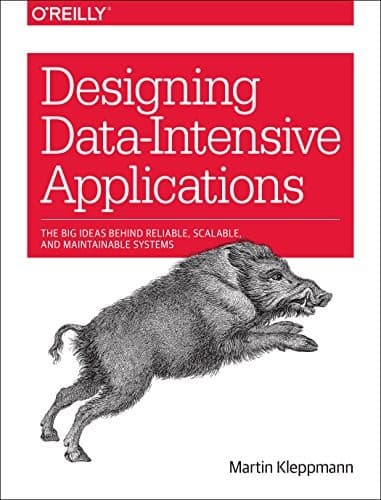
Designing Data-Intensive Applications
Guide by the Books of the Day editors · Updated · How we write our guides
A rare book that teaches how modern data systems really work, trade-offs included, so you can choose databases and architectures with reasoning rather than hype.
What Creators Say About Designing Data-Intensive Applications
2 creators reviewed Designing Data-Intensive Applications on YouTube between 2025 and 2026, with 298.6K views between them. Their opinions are their own; we picked these reviews, we didn't write them.
What It's About
This book is about the design principles behind systems that store, process, and move large amounts of data: databases, caches, search indexes, message queues, and batch and stream pipelines. Martin Kleppmann focuses less on any single product and more on the underlying trade-offs that every product has to make. That focus is why the material has aged better than most technology books, and why it still gets recommended to working engineers years after its 2017 first edition.
The style is prose-heavy and carefully reasoned, with diagrams and side-by-side comparisons that do much of the explaining. Each chapter builds on the last, and the author draws on examples from real systems and on the history of the field. He also takes care to separate what is well established from what is still debated. Expect to slow down in the chapters on replication, transactions, and distributed systems; they reward patient, careful reading and sometimes a second pass.
Reading it feels more like working through a graduate-level course with a thoughtful guide than skimming a technical manual. You finish with vocabulary and mental models for evaluating tools, not a how-to for a particular stack. Hands-on experience will still be needed to make those models stick, but the book gives you the questions to ask before you pick a technology, and that is the real payoff.
Read this if you…
- need to make decisions about databases, queues, or caches and want the reasoning behind them
- are a working backend or data engineer who wants depth beyond tutorials and vendor docs
- prefer understanding why a system behaves as it does over learning one tool's API
Skip it if you…
- want a hands-on, code-heavy tutorial to build something over a weekend
- are looking for a guide to one specific product, framework, or cloud service
Key Ideas
- 1
Reliability, scalability, and maintainability as core goals
Kleppmann treats these three words as the lens for every design choice. Reliability is about continuing to work correctly when things go wrong, scalability about coping with growth in load, and maintainability about how easily future engineers can understand and change the system. The value lies in seeing how these goals often pull against each other, so you learn to name the trade-off you are making rather than pretending it does not exist.
- 2
Data models and storage engines shape what is possible
The way data is modeled, whether relational, document, or graph, affects which queries are easy and which are awkward. Underneath, storage engines such as B-trees and log-structured designs make different bets on reads and writes. The book shows why a database's internal layout explains much of its performance profile, which helps you predict behavior instead of memorizing benchmarks that may not match your workload.
- 3
Replication and partitioning under real-world failure
Once data lives on several machines, you must decide how copies stay in sync and how the dataset is split across nodes. The author walks through leader-based, multi-leader, and leaderless approaches and the failure modes each invites, such as stale reads and conflicting writes. Partitioning is treated as the companion problem, with attention to hotspots and rebalancing. The discussion is practical about what can go wrong and why.
- 4
Transactions, consistency, and distributed system trouble
This is the most demanding part of the book. It explains what transactions guarantee, the different isolation levels and the anomalies they permit, and why distributed systems suffer from unreliable networks, clocks, and partial failures. The payoff is a clearer sense of what a database promises you, and what it quietly does not, when it claims to be consistent.
- 5
Batch and stream processing as one data flow
The later chapters connect offline batch jobs and real-time event streams into a single picture of how derived data is produced and kept up to date. The author discusses event logs, change data capture, and the idea of unbundling databases into composable parts. It is a useful framework for thinking about how systems fit together, even if you never run a streaming framework yourself.
Limitations
The book deliberately avoids step-by-step guidance for particular tools, so it will not tell you how to configure a given database. Code examples are sparse, and some readers find the prose dense going, especially in the transactions and distributed systems material. Because the first edition appeared in 2017, newer cloud services and managed offerings are not covered, and some specific product comparisons have dated. A few of the closing discussions about the future of data systems are the author's opinions rather than settled practice, which is worth remembering as you read.
Questions Readers Ask
- Do I need prior distributed systems experience to read it?
- No, but you should be comfortable with basic databases and web backends. The early chapters on data models and reliability are accessible to motivated readers. The later chapters on replication, consistency, and consensus are demanding, and many people find them easier after some real-world exposure to production systems.
- Is it still relevant given how much tooling has changed?
- Largely yes. Tools have changed, but the underlying trade-offs around replication, partitioning, isolation, and failure have not. The book teaches the concepts that let you evaluate new products, which is why it remains widely recommended. Expect to supplement it with current documentation for specific services.
- How does it compare to Database Internals by Alex Petrov?
- Database Internals goes deeper into how storage engines and distributed database algorithms are implemented. Designing Data-Intensive Applications is broader, covering the whole data landscape and the application-level trade-offs. Many engineers read both, starting with Kleppmann for the big picture and moving to Petrov for internals.
- Published
- 2017
- ISBN
- 9789352135240
- Difficulty
- advanced
- Category
- Tech
Book details and cover from Google Books.
Ready to read Designing Data-Intensive Applications?
Get your copy on Amazon, or listen to it on Audible. We earn a commission if you buy through these links.