
We earn a commission if you buy through these links. Learn more
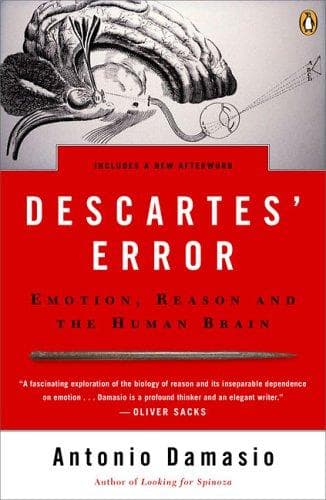
Descartes' Error
A neurologist's case-based argument that feeling is not the enemy of reason, showing how damage to emotional circuitry can ruin good decisions while leaving intelligence intact.
What It's About
Antonio Damasio is a neurologist who spent decades studying patients with brain injuries. The book opens with Phineas Gage, the nineteenth-century railway worker whose personality changed after an iron rod passed through his frontal lobe, and builds from there. Its central case is a patient Damasio calls Elliot, a man of normal intelligence who, after surgery removed a tumor affecting part of his prefrontal cortex, could analyze options endlessly yet could not make ordinary choices.
The argument is that rational decision-making relies on bodily feelings and emotional signals, which Damasio calls somatic markers, to flag options as promising or dangerous before deliberation gets far. He draws on clinical observation, laboratory card-gambling experiments in which people's physical responses shifted before they could consciously describe the pattern, and a critique of Descartes' separation of mind from body. The style is clinical yet readable, with case histories carrying most of the weight.
Reading it feels like being walked through a series of patient files by a careful clinician who is also arguing with a philosophical tradition. It is less a textbook than an extended essay, with stretches of neuroanatomy that require patience. Expect vivid cases and a steady, sometimes repetitive, insistence on the central point.
Read this if you…
- want to understand how emotion and the body shape everyday choices
- are curious about neurology and enjoy clinical case histories
- have been persuaded by pure logic and want a serious challenge to it
Skip it if you…
- want a practical self-help guide to making better decisions
- need a current overview of neuroscience, since the research has moved on
Key Ideas
- 1
Emotion as a guide to reasoning
Damasio proposes that past experiences leave bodily traces that color future options with a sense of good or bad. These signals narrow the field before careful analysis begins. On this view, emotion is not what disrupts good thinking but part of what makes it work at all, especially when choices are complicated and the outcomes are uncertain.
- 2
The Cartesian split between mind and body
Damasio challenges the old assumption that thought is a purely abstract process happening apart from the body. He argues that reasoning is grounded in the organism's physical states and its history of feeling. The book uses this critique to reframe familiar ideas about rationality, consciousness, and what it means to be a thinking person.
- 3
What damage to the prefrontal cortex reveals
The Gage and Elliot cases show that a person can keep their memory, language, and reasoning skills while losing the ability to decide sensibly. Their struggles with ordinary planning, social judgment, and choosing between options suggest that the frontal regions connect cold knowledge to the emotional values needed to act on it.
- 4
Feelings that operate before awareness
In the gambling-task experiments Damasio describes, participants showed physiological stress signals before they could explain which card decks were risky. The gap between the body's responses and conscious understanding is one of the book's most memorable findings, and it supports his claim that feeling can shape behavior ahead of explicit reasoning.
Limitations
Some of the science is dated, and later research has refined or contested parts of the somatic marker idea, including the gambling-task findings it relies on. The book's claims about how emotion works are often broader than the evidence from individual cases, and Damasio sometimes moves from lesion patients to large claims about human nature. Its discussion of consciousness and the self is less developed than the decision-making material. Some readers find the repetition and the neuroanatomy slow going.
Questions Readers Ask
- Is Descartes' Error still relevant today?
- Yes, both as an argument and as a landmark in the history of ideas. The core claim that emotion shapes decisions has held up well and influenced fields like behavioral economics and neuroeconomics. Some specific neuroscience is outdated, so it is best to read the case studies as illustrations of a theory that is still being tested rather than as settled facts.
- How does it compare to Thinking, Fast and Slow by Daniel Kahneman?
- Kahneman focuses on cognitive biases and the two systems of judgment, mostly through experiments on reasoning errors. Damasio asks a different question: what happens when the feeling side of the mind is damaged, and why reasoning depends on it. Kahneman is better for understanding mistakes, while Damasio is better for seeing emotion as part of good thinking.
- Published
- 1995
- ISBN
- 9781407065045
- Difficulty
- intermediate
Book details and cover from Google Books.
Ready to read Descartes' Error?
Get your copy on Amazon, or listen to it on Audible. We earn a commission if you buy through these links.