
We earn a commission if you buy through these links. Learn more
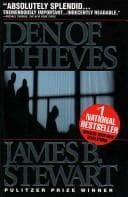
Den of thieves
by James B. Stewart, JAMES B. STEWART
A gripping, reported account of the 1980s insider trading scandals that exposed Wall Street's ethics, told through the traders and financiers who fell.
What It's About
Den of Thieves is a narrative account of the insider trading and securities fraud cases that shook Wall Street in the mid-to-late 1980s. James B. Stewart follows the investigations that toppled several high-profile dealmakers, centering on Ivan Boesky, the arbitrageur whose cooperation with prosecutors widened the case, and Michael Milken, the Drexel Burnham Lambert financier who had built the junk bond market. The early cases against lesser-known figures serve as the entry point to the larger story.
The approach is reportorial and scene-driven. Stewart reconstructs meetings, phone calls, and negotiations from interviews and documents, moving between prosecutors' offices, trading floors, and the boardrooms of firms suddenly under suspicion. It reads more like a thriller than a textbook, though the large cast can be hard to keep straight. The experience is one of watching a set of industry assumptions give way, as the line between aggressive dealmaking and crime is tested in court.
You do not need a finance background. Arbitrage, junk bonds, and takeover tactics are explained as they come up. The book is at its strongest on people and motives, and less interested in analyzing market structure or regulatory theory, so readers wanting that kind of economic argument will find it thinner than they might hope.
Read this if you…
- Want a vivid story about the 1980s Wall Street scandals and the people behind them
- Are curious how junk bonds and takeover finance became so central to modern markets
- Enjoy investigative narratives that read like a legal or financial thriller
Skip it if you…
- Want a rigorous analysis of market regulation or the economics of leverage
- Need an up-to-date account of financial crime or recent enforcement
Key Ideas
- 1
Insider trading as a network, not a lone act
Stewart shows how tips passed through a web of brokers, arbitrageurs, and corporate contacts. Prosecutors often broke one case to reach the next, so the scandal looks less like a few bad actors and more like an informal market for confidential information that many participants had quietly accepted.
- 2
Junk bonds and the leveraged buyout boom
The book explains how high-yield debt let smaller firms finance large takeovers, and how Milken's network made that market possible. It presents the boom as a genuine financial innovation whose incentives, and the pressure to keep deals flowing, helped push some participants toward illegal shortcuts.
- 3
Cooperation as the prosecutor's real weapon
Much of the story turns on who agreed to talk. Plea deals and cooperation agreements let investigators climb from one tier of the market to the next, and the book pays close attention to how fear of prison changed loyalties and reshaped the case.
- 4
Greed as culture rather than character flaw
Stewart argues that the excess was partly normalized inside firms that rewarded aggressive results. The reader is pushed to ask how ordinary professionals rationalized conduct that looked unacceptable from the outside, which makes the book more than a rogues' gallery.
Limitations
The book is from 1991, so it cannot reflect later developments in securities law, enforcement, or the careers of the people it covers. Its focus on a small group of central figures means it leaves out many smaller players and the broader structural questions about markets. Some readers find its dramatic reconstruction of private conversations hard to verify, and its sympathy tends to lie with the prosecutors and the investigative narrative. Readers should treat it as a strong account of one period rather than a complete history of insider trading.
Questions Readers Ask
- Do I need to know finance to enjoy Den of Thieves?
- No. Stewart explains arbitrage, junk bonds, and takeover tactics as the story needs them, and the core drama is about people and legal jeopardy. Some terms may still feel dense in places, but a curious general reader can follow the arc without prior knowledge.
- How does it compare to other books about the 1980s financial scandals?
- It is more narrative and character-driven than books that focus on market mechanics or regulatory theory. If you want a fast-paced, reported story of the cases and the people in them, it is a strong choice. If you want deeper analysis of why the system allowed the abuses, pair it with a more analytical history.
- Is it still relevant today?
- The core lessons about informants, plea deals, and how a culture of aggressive dealmaking can blur ethical lines still resonate. However, the regulatory environment and specific market practices have changed, so read it as a historical account rather than a guide to current rules.
- Published
- 1601
- ISBN
- 9780671638023
- Difficulty
- beginner
- Category
- Finance
Book details and cover from Google Books.
Ready to read Den of thieves?
Get your copy on Amazon, or listen to it on Audible. We earn a commission if you buy through these links.