
We earn a commission if you buy through these links. Learn more
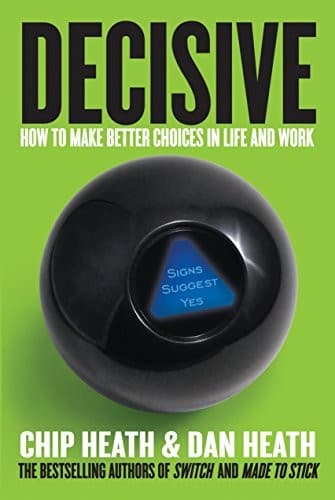
Decisive
Guide by the Books of the Day editors · Updated · How we write our guides
A practical, fast-reading toolkit for making better everyday and career decisions by spotting the mental traps that quietly shape our choices.
What Creators Say About Decisive
2 creators reviewed Decisive on YouTube between 2016 and 2017, with 146.2K views between them. Their opinions are their own; we picked these reviews, we didn't write them.
What It's About
Decisive is a practical guide from Chip and Dan Heath, the brothers behind Made to Stick and Switch, aimed at the choices people make at work and in their personal lives. Its starting point is that most decisions are made from a narrow set of options, shaped by gut reactions, confirmation bias, and overconfidence. Rather than offering one grand theory of judgment, the book lays out a short process for making sounder calls, built on research but translated into plain, usable tools.
The spine of the book is a four-step process the authors call WRAP: widen your options, reality-test your assumptions, attain distance before deciding, and prepare to be wrong. Each step targets a specific failure, and the chapters follow that sequence with many examples drawn from business, medicine, relationships, and public life. The tone is brisk and conversational, with frequent stories and clear summaries, so the book moves quickly.
Reading it feels closer to a workshop than a lecture. You come away with questions to ask before a big decision, checklists to revisit, and a clearer sense of where your thinking usually goes wrong. If you want rigorous detail on the psychology underneath, you will find it lighter than in dedicated books on cognitive bias, and that is by design.
Read this if you…
- want a fast, structured method for high-stakes choices
- often feel stuck between two options and want more alternatives
- make recurring decisions at work and want repeatable habits
Skip it if you…
- want a deep, academic treatment of cognitive bias and its research history
- prefer long narrative books with case studies that unfold over many chapters
Key Ideas
- 1
Narrow framing is the core problem
People usually compare two options, often the choice in front of them against doing nothing, and miss the wider range available. The book pushes you to generate alternatives, including ones you dislike. Its vanishing options test asks what you would do if your preferred choice were suddenly unavailable, which reveals how much of your thinking defaulted to the first two options on the table.
- 2
Test your beliefs against reality
Our information tends to confirm what we already think. The authors encourage you to ask what evidence would change your mind, to seek out people who disagree, and to consider the opposite of your preferred outcome. The goal is not to distrust yourself entirely but to stress-test assumptions before money, time, or reputation is committed.
- 3
Create distance from the moment
Emotion and short-term pressure distort decisions. The book offers ways to create space, such as asking how you will feel about a choice in ten minutes, ten months, and ten years, and imagining how a trusted outsider would view the situation. The point is to slow the decision enough that the immediate feeling does not do all the deciding.
- 4
Plan for being wrong
Because overconfidence is hard to escape, the authors recommend deciding in advance what would signal that a choice is not working. Setting tripwires, which are specific conditions that trigger a review, turns reversal from an admission of failure into a planned step. Imagining a project has already failed and asking why is another way to surface risks before they arrive.
Limitations
The book relies heavily on short anecdotes and brief summaries of research, so readers who want the full studies or methodological detail will need to look elsewhere. Some advice, such as considering alternatives or seeking outside views, may feel familiar to anyone who has read about decision-making before. Published in 2013, it predates much of the public debate about replication problems in behavioral science, so treat the strongest-sounding claims as useful heuristics rather than settled facts. It is also aimed at choices people can reflect on, so it has less to say about fast, time-pressured decisions.
Questions Readers Ask
- Is Decisive worth reading if I have already read Thinking, Fast and Slow?
- Probably only in part. Kahneman explains how judgment works in depth, while Decisive focuses on what to do about it. If you already know the common biases, the WRAP framework and its checklists will still help you apply that knowledge, but you may find less new science in the book. It is a quick read, so the time cost is modest.
- Does it apply to personal decisions as well as business ones?
- Yes. The authors draw examples from careers, business strategy, health, and relationships, and the questions work for choices like moving, changing jobs, or ending a relationship. Some tools, such as tripwires, fit ongoing projects most naturally, so you may need to adapt them for one-off personal choices.
- Published
- 2013
- ISBN
- 9780307361134
- Difficulty
- beginner
- Category
- Business
Book details and cover from Google Books.
Ready to read Decisive?
Get your copy on Amazon, or listen to it on Audible. We earn a commission if you buy through these links.