
We earn a commission if you buy through these links. Learn more
Dear Zoo
Guide by the Books of the Day editors · Updated · How we write our guides
A lift-the-flap picture book where every reveal is a small test of a toddler's prediction skills, making it one of the most reliable read-aloud choices for the very youngest children.
What Creators Say About Dear Zoo
2 creators reviewed Dear Zoo on YouTube in 2020, with 5.4M views between them. Their opinions are their own; we picked these reviews, we didn't write them.
What It's About
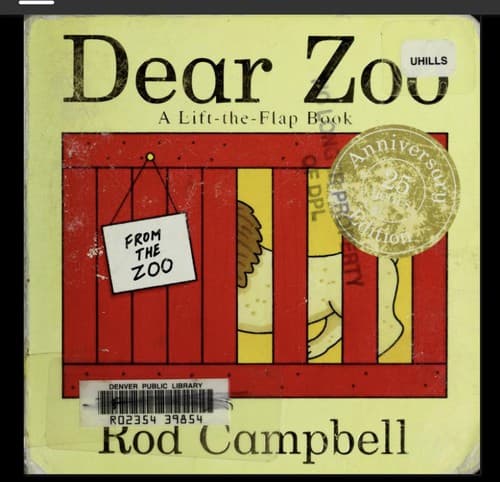
Dear Zoo is a lift-the-flap picture book for toddlers and preschoolers, first published in 1982. A child writes to the zoo asking for a pet, and each animal that arrives in its crate is found wanting, whether too big, too wild, or otherwise unsuitable. Young readers lift flaps to discover what is inside each box, and the text is short, rhythmic, and built to be read aloud.
The approach is simple and deliberate. Each spread follows the same pattern, so a small child can predict the rhythm, anticipate the reveal, and join in with animal names and sounds. The flat, bright illustrations keep attention on shapes and colours rather than fine detail, which suits children who are still learning to focus on a page. The experience is closer to a game than a story: an adult reads, a toddler lifts, and the small suspense lies in what comes out next.
For adults, the pleasure is mostly watching a young child's attention work. It is a short book, usually finished in a few minutes, and it rewards repetition. Sturdy board-book editions exist for the youngest readers, which makes it practical as well as charming.
Read this if you…
- want a board book that works for toddlers who are just starting to enjoy stories
- are looking for an interactive read-aloud that keeps a wriggly child engaged
- want a classic picture book with clear, bright art and a predictable rhythm
Skip it if you…
- want a story with plot, character development, or a surprising ending
- are seeking a book for older children or adults who want something substantial
Key Ideas
- 1
Repetition as a learning tool
The book repeats the same structure on almost every page. For a toddler, that predictability is the point: they learn the pattern quickly, feel clever for guessing the next animal, and start to participate. Repetition builds confidence and vocabulary without any explicit lesson being taught.
- 2
Anticipation built into the design
The lift-the-flap format turns the page into a small moment of suspense. A child must physically act to reveal the answer, so the reading becomes interactive. Much of the book's appeal comes from this mechanical pleasure rather than from its words, which is why it works even before a child can follow a plot.
- 3
Matching needs to a companion
Beneath the simple premise is a gentle idea about choosing a companion that fits. Each animal fails for a reason a small child can understand, such as being too large for the house or too wild for a bedroom. The contrast with the final choice gives the book a quiet emotional shape without any moralising.
- 4
Restrained, legible illustrations
The artwork is deliberately simple, with clear outlines and bold colour fields. Nothing competes with the flap or the animal in view. This restraint makes the book easy to read from a distance and easy for a child to understand on their own, which is part of why it has lasted.
Limitations
The story is very slight, and the child at its centre is largely a bystander who never speaks or acts beyond writing the letter. Adults who read it many times may find the structure repetitive, and some readers feel the ending is more pleasant than inventive. It is not a book for independent readers, and its appeal depends almost entirely on how well it is read aloud and how much a child enjoys lifting flaps.
Questions Readers Ask
- Who is Dear Zoo best suited for?
- It suits babies, toddlers, and preschoolers, especially those who enjoy interactive books. Parents and carers often find it a dependable choice for bedtime or waiting rooms. Because the text is brief and predictable, it works well for children just starting to join in with the words and animal sounds.
- Is Dear Zoo still worth reading today?
- Yes, for its intended audience. The lift-the-flap mechanism and repeated pattern still do the job they did decades ago, and the simple illustrations have aged well. Newer interactive books exist, but many parents return to this one because it is short, sturdy, and easy to share.
- How does it compare to other lift-the-flap books?
- Many lift-the-flap books rely on more elaborate paper engineering or richer illustrations. Dear Zoo is more modest: its strength is its rhythm and its clear, small-scale payoff. If a child wants more complex mechanics, a different title may suit better, but for a first flap book it is hard to beat.
- Published
- 1982
- ISBN
- 9781529074932
- Difficulty
- beginner
- Category
- Fiction
Book details and cover from Google Books.
Ready to read Dear Zoo?
Get your copy on Amazon, or listen to it on Audible. We earn a commission if you buy through these links.