
We earn a commission if you buy through these links. Learn more
Dear primo
A short bilingual picture book written as a child's letter to a faraway cousin, it finds big feelings of distance and belonging in ordinary, everyday comparisons.
What It's About
Dear Primo is a short picture book written as a letter from a young narrator to his cousin, a child he knows mostly through family ties and the distance between them. The premise is simple: the writer tells his cousin about the everyday differences between their lives, and the letter itself becomes the way the two children stay connected. The gap between the two households gives the book its quiet momentum, and readers are invited to notice what is shared and what is not.
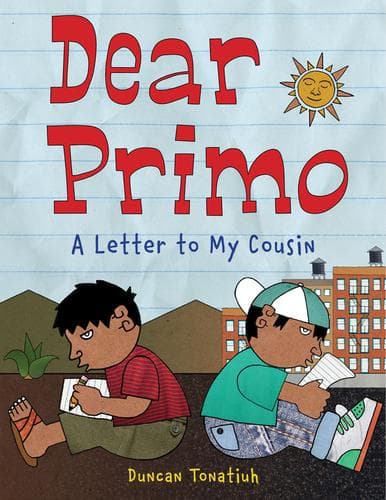
The text moves between Spanish and English, so readers encounter both languages in context rather than through a glossary. Tonatiuh's illustrations draw on the flat, geometric style of ancient Mesoamerican picture writing, with bold colors and simplified figures that carry much of the emotional information. The pages are sparse, so a reader can finish in one sitting, but children and adults tend to linger on the pictures and the small comparisons that build up across the book.
Reading it is less like following a plot than like overhearing a warm, honest letter. The emotional register is affectionate and curious rather than dramatic. Its effect depends on the reader's willingness to notice what a letter leaves out, and adults reading aloud often find the book opens conversations about home, language, and belonging.
Read this if you…
- want a short picture book that opens real conversations about family, language, and home
- are interested in how visual art can carry cultural history and emotion
- are looking for a bilingual book that treats Spanish as a natural part of the story
Skip it if you…
- want a picture book with a strong plot, conflict, or a clear resolution
- are looking for a detailed, step-by-step explanation of Mesoamerican art or history
Key Ideas
- 1
A letter as a bridge across distance
The book's form does most of the work. Writing to someone far away makes the narrator describe his world carefully, choosing what to share and what to explain. The reader sees the narrator's life through a chosen lens, which makes the act of communicating itself a central subject.
- 2
Two languages living side by side
Spanish and English appear together rather than one being translated for the other. This reflects how bilingual families actually speak, and it asks readers to hold both languages at once. Children who know only one language may feel a little outside the text, which can be a useful experience.
- 3
Ancient visual traditions in a modern story
The art borrows from Mesoamerican picture writing, linking a personal, present-day letter to a long visual heritage. The flat shapes and bold colors give the family story a sense of history and identity, so the everyday details feel placed within something larger.
- 4
Belonging shaped by where you live
Through small comparisons, the book suggests that identity is partly made from place, family, and language. It avoids easy conclusions and lets the reader see how two children can share a bond while living very different daily routines.
Limitations
The book is brief, and some readers may find it slight, especially those looking for dramatic tension or a developed narrative arc. Its emotional force depends on the reader connecting with the idea of distance between family members, which not every child or adult will bring to it. Because it is a picture book, its Spanish and English usage is shaped for a young audience, and bilingual readers with different family backgrounds may find the language choices uneven. It also does not explain its cultural references in depth, so readers wanting more context may need to look elsewhere.
Questions Readers Ask
- Who is Dear Primo best for?
- It suits young children, roughly early elementary age, and the adults who read with them. It is especially good for families with relatives in other places or for bilingual households. Older readers may enjoy the art and the quiet emotional tone, but they will likely find the text short and the story simple.
- Is Dear Primo still relevant?
- Its themes of family, distance, and language remain widely recognizable, so it still feels current for many readers. The art style is the most distinctive element, and it has a timeless quality. Readers looking for up-to-date commentary on migration or cross-border life may want to pair it with newer books.
- How does it compare to other bilingual picture books?
- Many bilingual picture books focus on translation or on a single language being taught. Dear Primo is more interested in letting both languages coexist naturally within a personal letter. Readers who enjoy this approach may also like other picture books that use family correspondence or memory as their central frame.
- Published
- 2009
- ISBN
- 9786078614080
- Difficulty
- beginner
- Category
- Fiction
Book details and cover from Google Books.
Ready to read Dear primo?
Get your copy on Amazon, or listen to it on Audible. We earn a commission if you buy through these links.