
We earn a commission if you buy through these links. Learn more
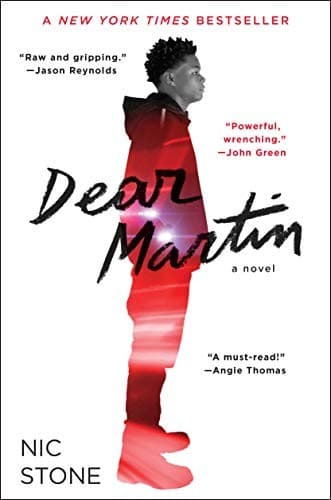
Dear Martin
by Nic Stone
Guide by the Books of the Day editors · Updated · How we write our guides
A sharp, emotionally direct YA novel about a Black honor student whose letters to Martin Luther King Jr. become a way to work through racism, police violence, and what justice demands.
What Creators Say About Dear Martin
2 creators reviewed Dear Martin on YouTube between 2018 and 2020, with 13.9K views between them. Their opinions are their own; we picked these reviews, we didn't write them.
What It's About
Dear Martin follows Justyce McAllister, a Black teenager who wins a place at a mostly white private school and works hard to fit into a world that still treats him with suspicion. After an encounter with police leaves him handcuffed and humiliated, he begins writing letters to Martin Luther King Jr. to sort out what he's experiencing and what he believes about justice, anger, and how to respond to injustice.
The prose is quick and direct, told in the first person with plenty of dialogue and short chapters that keep the momentum going. The letters give readers a close look at Justyce's private reasoning, including the moments when he is confused, furious, or wrong, so the book feels more like an argument with a hero than a lecture. Stone puts characters with different views in the same room and lets their disagreements carry weight rather than resolving them neatly.
Reading it feels urgent and personal. It works best as a YA novel with a strong moral center, built to provoke discussion and to make readers sit with uncomfortable questions about race, policing, and how young people respond to harm. Expect a book more interested in asking hard questions than in offering tidy answers, one that is easy to read quickly and then want to talk about.
Read this if you…
- want a YA novel that tackles racism and police violence head-on
- are a teen, teacher, parent, or librarian looking for a discussion-friendly book
- like character-driven stories told in short, direct chapters
Skip it if you…
- want a subtle, ambiguous literary novel rich in imagery and slow reflection
- prefer social commentary in nonfiction form, backed by sources and data
Key Ideas
- 1
Achievement does not shield you from racism
Justyce works hard, earns good grades, and plays by the rules, yet the book keeps showing that none of this protects him from suspicion or hostility. The novel argues that respectability politics have limits, and that Black teens are judged by how they look before anyone learns what they have done or who they are.
- 2
Anger versus nonviolent resistance
Justyce's rage collides with the nonviolent philosophy of King, the figure he is writing to. Rather than presenting King as a simple answer, the letters test whether his ideas still work for a teenager who feels powerless and betrayed. Readers are invited to weigh the costs of both passion and restraint.
- 3
Friendship strained by different experiences
Justyce's friends and classmates do not share his view of what happened, and the gap between their lives becomes a central source of tension. The book shows how people who care about each other can still misread one another when their experiences of race and safety differ sharply.
- 4
Writing as a way to think through pain
The letter format turns the novel into a record of a mind in progress. Because Justyce is reasoning on the page, readers see his conclusions form, shift, and sometimes fall apart, which makes the moral questions feel earned rather than delivered.
Limitations
Critics often say the book leans toward the didactic, with some characters functioning more as mouthpieces for opposing views than as fully realized people. Some plot turns and coincidences can feel convenient. The story centers one young man's perspective in a fairly specific setting, so it does not explore the wider range of Black experiences, including differences of class, gender, and region. As a debut, its prose is plain and functional rather than lyrical.
Questions Readers Ask
- Is Dear Martin appropriate for middle grade readers?
- It is generally marketed to older teens. It includes strong language and graphic depictions of police violence, and its themes are heavy. Parents of younger readers may want to preview it or read it together so they can talk through the scenes that are hardest to sit with.
- How does Dear Martin compare to The Hate U Give?
- Both are popular YA novels about police violence seen through a Black teenager's eyes. The Hate U Give spreads its focus across family and community, while Dear Martin concentrates more tightly on one protagonist's inner reasoning and his arguments with King's ideas. Readers who liked one often find the other worth reading next.
- Published
- 2017
- ISBN
- 9781101939499
- Difficulty
- beginner
- Category
- Young Adult
Book details and cover from Google Books.
Ready to read Dear Martin?
Get your copy on Amazon, or listen to it on Audible. We earn a commission if you buy through these links.