
We earn a commission if you buy through these links. Learn more
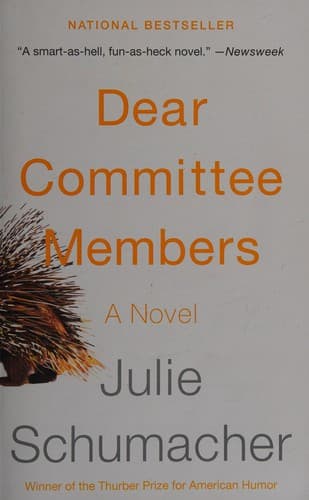
Dear Committee Members
A sharp, funny novel told entirely in recommendation letters and memos, following a faded novelist-professor whose wit exposes both a shrinking university and his own failings.
What It's About
Dear Committee Members is a novel told almost entirely in documents: letters of recommendation, emails, memos, and the occasional stray note, all written by Jay Fitger, a fiction writer who teaches in the English department of a small, struggling Midwestern university. Over the course of an academic year, the reader sees his professional life through the requests that pile up on his desk. Each letter is a small performance, and the gap between what he writes for others and what he actually feels becomes the engine of the book.
Schumacher's approach is comic and sharp, and the form does much of the work. Because we see only one side of each correspondence, we infer the rest: the students who need him, the colleagues who need him more, and the administrators who keep taking things away. The humor often lands at Jay's own expense. He is vain, wounded, and occasionally unkind, which keeps the book from becoming a simple lament about budgets.
Reading it feels like eavesdropping on a very articulate man's worst year. It is quick, funny, and easy to finish in a few sittings, but it also carries a real undertow about who gets to stay, what writing is for, and how institutions treat the people who teach. Expect a book driven by tone and character more than by plot.
Read this if you…
- enjoy comic novels told through letters, memos, and emails
- have spent time in universities or other slow-moving institutions and like satire about them
- prefer a witty, character-driven voice to a plot-heavy story
Skip it if you…
- need a fast-moving story with a clear sequence of events and conventional scenes
- find unlikable narrators hard to spend hundreds of pages with
Key Ideas
- 1
The recommendation letter as performance
Jay's letters are supposed to be simple professional favors, but he uses them to show off his wit, settle scores, and reveal his mood. The book keeps asking what a letter is really for: a fair assessment of a student, a display of the writer's own cleverness, or a quiet form of self-advertisement. Watching the distance between the stated purpose and the actual content is much of the pleasure.
- 2
A university in slow decline
The English department is shrinking, budgets are being cut, and the administration speaks in the language of efficiency and metrics. The novel treats these pressures as a backdrop that shapes every small decision, from who gets a course to who gets a sympathetic hearing. It is satire, but it is grounded in the kind of institutional frustration many academics will recognize.
- 3
A protagonist whose humor exposes him
Jay is funny, and he knows it, but his jokes frequently reveal his insecurity, his grudges, and his sense of being overlooked. The reader laughs with him and then notices what the laughter is covering. This tension keeps the comedy from feeling safe and makes the book more than a string of office gags.
- 4
Faded literary ambition and the writing life
Jay's past as a published novelist hangs over the present, shaping how he sees his students, his colleagues, and himself. The book asks what happens to a writer once the early promise has passed and the job becomes a way of paying the bills. It is a quieter theme than the satire, but it gives the letters their emotional weight.
Limitations
The epistolary form keeps the story at arm's length. We rarely see scenes unfold directly, and the other characters exist only as far as their replies or Jay's descriptions reveal them, so emotional payoffs can feel muted. Some readers find Jay's self-absorption wearing over a full novel, and the academic satire may land harder for those who know campus life than for general readers. The comedy also relies on a recognizable repetition of grievances, which some will find thin by the end. Those who want a fuller portrait of the university's people may come away wanting more.
Questions Readers Ask
- Is Dear Committee Members a good choice if I have never read an epistolary novel?
- Yes, it is one of the more accessible entries in the form. The letters are short, the voice is conversational, and the story is carried by the gaps between what Jay says and what he means. You will pick up the structure within a few pages, and most readers find it moves quickly.
- How does it compare to campus novels like Stoner or Lucky Jim?
- It shares the academic setting and some of the satirical bite of Lucky Jim, but it is more fragmented and less interested in a conventional arc. Compared with Stoner, it is far lighter in tone and much funnier, though it shares an interest in what a life in teaching and writing costs over time.
- Published
- 2014
- ISBN
- 9780385538138
- Difficulty
- beginner
- Category
- Fiction
Book details and cover from Google Books.
Ready to read Dear Committee Members?
Get your copy on Amazon, or listen to it on Audible. We earn a commission if you buy through these links.