
We earn a commission if you buy through these links. Learn more
Dawn
Butler's first Xenogenesis novel asks what survival costs when your rescuers are not human and their help comes with conditions. It is uncomfortable, morally serious, and unlike most science fiction you have read.
What It's About
Dawn is the opening book of Octavia E. Butler's Xenogenesis trilogy, often published together as Lilith's Brood. It begins after a nuclear war has left Earth badly damaged, and its central figure, Lilith Iyapo, wakes up in the custody of the Oankali, an alien species that preserved the surviving humans, healed the planet, and now intends to change what it means to be human. Lilith is not simply a captive. She is given responsibilities, and the narrative stays close to her perspective as she tries to work out what her captors want and what they expect in return.
The book is slower and more interior than its premise suggests. Much of the tension comes from conversation, negotiation, and the slow discovery of what the Oankali's offer actually involves. Butler is less interested in spectacle than in the bodily, social, and ethical details of the arrangement, and she makes you sit with them. Some scenes are hard to read, and the book does not soften its discomfort to make you feel better.
Reading Dawn feels like being handed a question and then made to live inside it. You will likely finish it wanting to argue with it, which is part of its design. It rewards patience and close attention more than fast plot momentum.
Read this if you…
- like science fiction that uses alien contact to examine power, consent, and identity
- are willing to read slow, conversational, morally dense novels
- want to see how Butler's ideas about race and human nature were developed before the rest of the trilogy
Skip it if you…
- want fast-paced action, space battles, or a clear heroic arc
- need a hopeful story with a comfortable resolution
Key Ideas
- 1
Survival that comes with conditions
The Oankali have saved humanity from extinction, but rescue is not free. Butler keeps asking what a people should give up to live, and whether being alive on someone else's terms still counts as living. The novel treats gratitude and resentment as tangled feelings that do not resolve neatly, and it refuses to let the reader settle on a simple verdict about the Oankali.
- 2
Bodies, consent, and genetic exchange
The central proposal concerns reproduction and genetic merging, and Butler explores it through the body rather than abstraction. The book asks how consent works when one side has far more power and understanding, and whether a change that is good for the species can still be a violation for the individual. These questions are raised repeatedly, so they feel less like a single debate and more like a pressure that builds.
- 3
Human hierarchy seen from outside
Through the Oankali's eyes, humans look like a species driven by hierarchy, hostility, and a tendency toward self-destruction. Butler uses this outside perspective to examine human behavior, including racism and the will to dominate, without giving the reader an easy place to stand. The critique lands because the book makes you consider whether the Oankali's judgment is fair.
- 4
Lilith as a shaped and damaged narrator
Lilith's history of loss, her memories of the old world, and her identity as a Black woman all shape how she reads her captors and her own choices. Her inner life is the book's emotional anchor, and her uncertainty about what is right is more interesting than any single position she takes. The novel works because she is a convincing, flawed mind rather than a symbol.
Limitations
Some readers find the pacing slow, especially in the early sections where the setting and rules are established through negotiation rather than action. The Oankali's biology and motives can feel abstract, and the book's central premise is hard to accept without reservations, which some readers see as a deliberate tension and others as a weakness. The sexual and bodily content is frank and may be uncomfortable for some. Because the book was written in the late 1980s, its treatment of gender and genetics reflects that moment, though its questions remain current.
Questions Readers Ask
- Do I need to read the other Xenogenesis books after Dawn?
- Dawn is a complete novel with a complete arc, but it is the first of a trilogy and the later books, Adulthood Rites and Imago, continue the story and explore its ideas further. If you enjoy Dawn, reading the rest will give you a fuller picture. If you find it heavy going, you can stop there without feeling you have missed the point of the first book.
- Is Dawn still relevant today?
- Yes. Its concerns about consent, power imbalances, genetic engineering, and the human tendency toward conflict remain pressing. Readers often find its questions more relevant now than when it was published in 1987, though some of its assumptions about gender and biology reflect the period in which it was written.
- Published
- 1987
- ISBN
- 9781453265482
- Difficulty
- intermediate
- Category
- Fiction
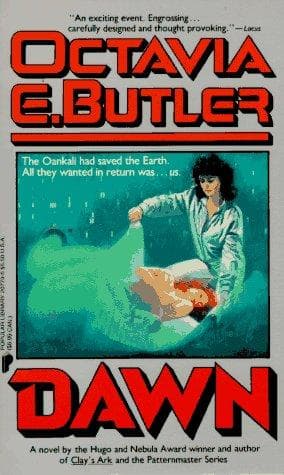
Book details and cover from Google Books.
Ready to read Dawn?
Get your copy on Amazon, or listen to it on Audible. We earn a commission if you buy through these links.