
We earn a commission if you buy through these links. Learn more
Dawn
by Elie Wiesel, Frances Frenaye
Guide by the Books of the Day editors · Updated · How we write our guides
A short, unsettling novel in which a Holocaust survivor waits through one night for a violent task in postwar Palestine, making it a demanding meditation on conscience and revenge.
What It's About
Dawn is a short, intense novel told almost entirely through the thoughts of Elisha, a young Jewish man in British-ruled Palestine in the years after the Second World War. He has been given a single assignment tied to the underground struggle against British rule, and much of the book takes place in the hours before he must act. The action is minimal. What drives the story is Elisha's interior life: his memories of Europe and the camps, his arguments with himself, and his growing unease with what he has agreed to do.
The style is spare, lyrical, and often repetitive, with long reflective passages that circle the same questions from different angles. Wiesel writes in a way that feels closer to a prayer or a confession than to conventional plot-driven fiction. Sentences are carefully weighed, and the narrative moves slowly, so the reader stays inside the character's head for the whole night.
Reading Dawn is a heavy, absorbing experience. It can be finished in an afternoon, but it lingers for much longer. The book rewards patience and close attention, and readers who want fast momentum or clear-cut answers may find it frustrating. Its power lies in how little it settles and how persistently it keeps its moral questions open.
Read this if you…
- want a short, serious novel about moral responsibility and revenge
- are interested in Elie Wiesel's writing beyond the memoir Night
- enjoy slow, reflective prose that rewards rereading
Skip it if you…
- need a fast-paced plot with a lot of external action
- want a straightforward historical account of the Palestine conflict
Key Ideas
- 1
Justice weighed against an individual life
The novel's central tension is whether a cause can justify killing a specific person who had no part in the wrongs being avenged. Wiesel keeps the target human and close at hand, so the abstract logic of retaliation keeps running into a face and a name. The discomfort the reader feels is the point.
- 2
The Holocaust as the shadow over political violence
Elisha's decision cannot be separated from what he survived. Memories of the camps and of loss shape how he understands revenge, mercy, and the idea of a Jewish state fighting for itself. Wiesel asks whether suffering creates a right to act, or whether it creates a duty to refuse the cruelty that caused it.
- 3
Conscience inside a collective commitment
Elisha is part of a group whose decisions he did not fully make alone, and the book examines how belonging to a movement can press a person toward acts he would not choose privately. The tension between personal conscience and loyalty to comrades runs through nearly every page.
- 4
A single night as the book's structure
The whole novel unfolds across one night before dawn, which gives it a tight, ritual-like shape. The approaching morning functions as a clock that makes every thought feel urgent. This compression is what makes the book feel more like a sustained moral trial than a conventional narrative.
Limitations
Dawn is deliberately sparse, and many readers find its long interior passages repetitive or abstract. The novel gives only a narrow view of the political situation, focusing on one character's conscience rather than the wider history of the British mandate or the Jewish underground. Readers looking for context on those events will need to look elsewhere. Some critics have also felt that the book's moral framing is more an attitude than an argument, leaving certain questions more asserted than fully worked out. The book's emotional intensity can also be heavy for readers who are sensitive to violence or to Holocaust material.
Questions Readers Ask
- Is Dawn a sequel to Night?
- Dawn is often grouped with Night and Day as part of a loose trilogy by Wiesel, linked by themes of memory, faith, and the aftermath of the Holocaust. However, it is a separate novel with its own characters and setting. You do not need to have read Night first, though readers who have may recognize its concerns with suffering and conscience.
- Who is Dawn best suited for?
- Dawn suits readers who appreciate philosophical fiction and do not mind a slow, interior pace. It works well for those interested in ethics, political violence, or Holocaust aftermath. Readers who prefer brisk plots or detailed historical background may find it less satisfying, but it is a rewarding short read for anyone who wants to think hard about a difficult question.
- Published
- 1961
- ISBN
- 9781419396724
- Difficulty
- intermediate
- Category
- Fiction
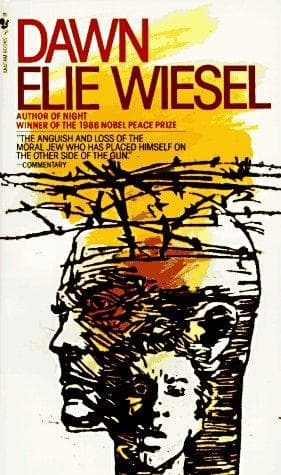
Book details and cover from Google Books.
Ready to read Dawn?
Get your copy on Amazon, or listen to it on Audible. We earn a commission if you buy through these links.