
We earn a commission if you buy through these links. Learn more
Darwin's dangerous idea
Guide by the Books of the Day editors · Updated · How we write our guides
Dennett's case that Darwin's principle of natural selection explains far more than biology, from minds to morality, and why that argument still unsettles readers.
What Creators Say About Darwin's dangerous idea
2 creators reviewed Darwin's dangerous idea on YouTube between 2011 and 2023, with 1.8K views between them. Their opinions are their own; we picked these reviews, we didn't write them.
What It's About
Published in 1995, Darwin's Dangerous Idea argues that Charles Darwin's theory of natural selection is much bigger than a theory about finches and fossils. Daniel Dennett, a philosopher of mind, contends that selection is a general, mindless process that can produce complexity without any designer, and that it therefore reaches into questions people assumed belonged to someone else: how minds arise, where morality comes from, and what meaning a human life can have. He calls the idea dangerous because it removes the need for a creator and unsettles the belief that humans stand apart from nature.
The approach is philosophical and combative. Dennett builds his case through analogies, thought experiments, and long arguments with rival thinkers, including Stephen Jay Gould, whose views he tests closely. The writing is conversational and often witty, but it is also dense, and it repeatedly pauses to defend the logic of its claims. Much of the book goes to clarifying what evolution does and does not assert, rather than to new field evidence or detailed case studies.
Reading it feels like sitting in on a long, sharp seminar. You will not come away with a stack of new biological facts, but you will get a set of tools for thinking clearly about design without a designer, and a better sense of where Darwinian explanations apply and where they are often stretched too far. Patient readers will find it rewarding; those wanting a quick science read may find it heavy going.
Read this if you…
- want to understand the philosophical implications of evolution, not just its biology
- are interested in how minds, ethics, or culture could arise from unguided processes
- enjoy long, argumentative books that take on specific rival thinkers
Skip it if you…
- want a readable introduction to evolutionary biology or recent genetic research
- find long philosophical digressions and debates about other scientists tiring
Key Ideas
- 1
Evolution as a mindless algorithm
Dennett's central move is to treat natural selection as a process with a simple structure: variation, inheritance, and differential survival, repeated over time. No foresight or intention is needed. Once you accept that such a process can build eyes and wings, he argues, you have to accept that it can build much else, and that the 'mind first' assumption behind many explanations is not required.
- 2
Skyhooks versus cranes in explanation
Dennett uses the image of skyhooks, unexplained lifts that suddenly produce order, and cranes, gradual mechanisms that can be inspected step by step. He argues that a good explanation of life and mind should be a crane. The contrast gives readers a practical test for spotting explanations that quietly assume the answer, including some religious and mystical accounts of human uniqueness.
- 3
Darwinism as a universal acid
Dennett describes the idea as acid that eats through conventional boundaries, dissolving the wall between natural and supernatural explanations and making it hard to keep older categories intact. The image is memorable and frames much of the book's ambition. It also invites the question of which boundaries should really dissolve and which only appear to be in the way.
- 4
Cultural evolution and the meme concept
Dennett extends selection-style thinking to ideas, customs, and technologies, which he calls memes. He suggests cultural traits can spread and change through similar selective pressures. This section is among the most debated parts of the book, since many scientists find the analogy loose, but it shows how Dennett thinks about human knowledge and institutions as things that evolve.
- 5
Meaning and morality without a designer
The later chapters ask what follows for ethics and purpose once design is no longer the starting point. Dennett argues that moral values and human meaning can be understood as products of natural processes without becoming meaningless. Readers who care about these questions will find a substantive, if contestable, account rather than a loose appeal to science.
Limitations
Critics argue that Dennett overreaches, using a biological principle to settle questions in ethics, religion, and philosophy of mind that involve much more than selection. His polemics against Gould and other opponents can feel personal and slow the book down. The meme concept has not developed into the scientific program he hoped for. Some passages about computation and artificial intelligence now read as dated, and his treatment of religion is often more dismissive than a careful reader might want.
Questions Readers Ask
- Is Darwin's Dangerous Idea still relevant today?
- Yes. Its core argument about natural selection as a general, unguided process still shapes debates about evolution, minds, and artificial intelligence. Some of the specific science has moved on, especially in genetics and developmental biology, so treat the empirical details as a snapshot. The philosophical framework remains the main reason people still read it.
- How does it compare to Richard Dawkins's The Selfish Gene?
- Dawkins's book is shorter and more focused on a gene-centered view of evolution. Dennett's is broader and more philosophical, spending more time on implications for religion, ethics, and the mind. Read Dawkins first if you want the biology, and Dennett if you want to think through what the biology means.
- Published
- 1995
- ISBN
- 9789046702536
- Difficulty
- advanced
- Category
- Science
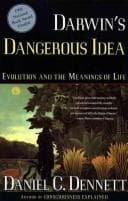
Book details and cover from Google Books.
Ready to read Darwin's dangerous idea?
Get your copy on Amazon, or listen to it on Audible. We earn a commission if you buy through these links.