
We earn a commission if you buy through these links. Learn more
Cry, the Beloved Country
by Alan Paton
Guide by the Books of the Day editors · Updated · How we write our guides
A slow, lyrical novel about a rural pastor's search through Johannesburg for his missing family, and one of the earliest major novels to expose the moral damage of South African racial division.
What Creators Say About Cry, the Beloved Country
2 creators reviewed Cry, the Beloved Country on YouTube between 2020 and 2024, with 77.7K views between them. Their opinions are their own; we picked these reviews, we didn't write them.
What It's About
Cry, the Beloved Country is a novel, though it is often shelved as history because of its subject. Stephen Kumalo, an elderly Zulu pastor from a village in the Natal hills, travels to Johannesburg after letters from his family stop coming. He is searching for his sister and his son, and the city he finds is one of mines, crowded townships, and violence. The book follows his journey alongside a white farmer whose own life is changed by a loss in the city.
Paton writes in short chapters with the cadences of the King James Bible. Descriptions of the land are slow and mournful, and dialogue mixes English with Zulu phrases and the speech of people speaking across a language divide. Reading it is an emotional experience more than an intellectual one. It asks you to sit with grief, to notice small acts of kindness, and to feel the weight of a society built on fear.
Written in 1948, as apartheid was being put into law, the novel captures a moment when many white South Africans were only beginning to face what their country was becoming. It is not a documentary. Its characters are invented, and its vision is shaped by one author's conscience and beliefs. Read it as a powerful human portrait of a historical moment, not as a complete account of it.
Read this if you…
- want a slow, emotionally serious novel with a strong sense of place
- are interested in how South African society was described by writers during apartheid
- appreciate prose that borrows the rhythm and weight of scripture
Skip it if you…
- need fast plot momentum or a tightly structured thriller
- prefer historical books with direct evidence, analysis, and footnotes over fiction
Key Ideas
- 1
The land as a mirror of society
Paton returns again and again to eroded hills, dried riverbeds, and farms that have been stripped of their soil. The damage to the land runs parallel to the damage to people. Reading the landscape as a moral record is one of the book's most rewarding tasks, and it makes the novel's sorrow feel rooted in place rather than abstract.
- 2
Fear as the engine of injustice
Much of what goes wrong in the novel is driven by fear on both sides of the color line. Paton shows how people who are afraid protect themselves by narrowing their sympathy. He does not treat fear as a simple villain, and he shows its effects on ordinary decent people as much as on those who are openly cruel.
- 3
Shared guilt across racial lines
The novel refuses to let any single group stand outside responsibility. Its characters must face what their own silences and comfortable assumptions have allowed. This theme makes the book uncomfortable, and its moral force depends on that discomfort rather than on easy blame.
- 4
Faith tested rather than affirmed
Kumalo's Christianity is central to his identity, yet the novel does not simply confirm it. His faith is stretched by what he sees and suffers. Readers who expect a straightforward religious story may find the book more searching and doubtful than they anticipated, and that tension gives Kumalo's inner life its depth.
Limitations
Critics have pointed out that Paton, a white South African writing largely for white readers, sometimes filters Black experience through a sympathetic but paternalistic lens. Some characters, especially the women, are sketched thinly. The prose can feel sentimental and repetitive to modern readers, and its hopeful, reconciliatory ending may seem too neat given how the political situation developed afterward. The book also covers only a narrow slice of the country's history and does not explore the perspectives of the political movements of the time in depth.
Questions Readers Ask
- Is Cry, the Beloved Country still relevant today?
- Yes. Its portrait of the economic and social divides between city and countryside, and of how fear shapes relations between communities, still resonates with readers. Some of its political assumptions are dated, so it works best read alongside more recent South African writing that centers Black authors and voices.
- How does it compare to Things Fall Apart?
- Both novels are about a traditional community facing rapid, destructive change and a protagonist caught between old and new worlds. Paton's book is quieter and more mournful, with a Christian moral frame. Achebe's is sharper and more formally experimental. Readers who like one often find the other rewarding, though they are very different in tone.
- Published
- 1940
- ISBN
- 9780140012743
- Difficulty
- intermediate
- Category
- History
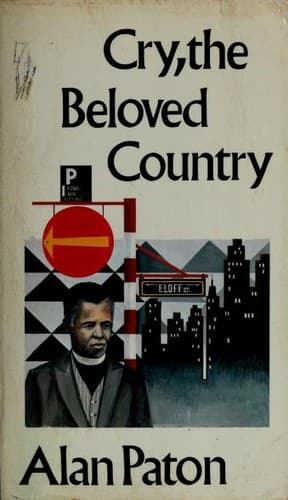
Book details and cover from Google Books.
Ready to read Cry, the Beloved Country?
Get your copy on Amazon, or listen to it on Audible. We earn a commission if you buy through these links.